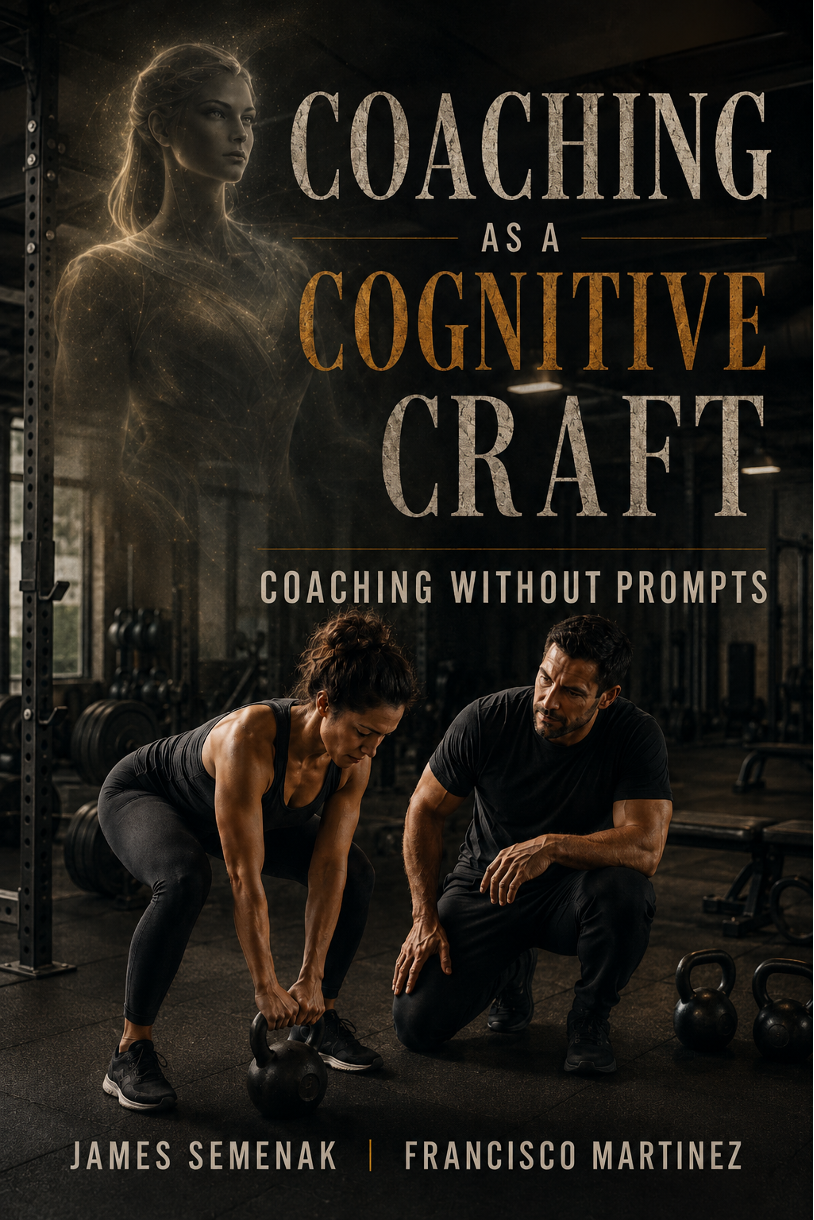
Coaching Without Prompts
Coaching as a
Cognitive Craft
Coaching Without Prompts
A trainer's hardest work is invisible — holding the body, the history, the reasoning behind every call. Most tools manage the surface. Trainer Intelligence™ is built to share that load instead of taking it over. A partner. Without prompts.
Apply for the Pilot →The book is on the runway.
Release date and pre-order details land here as soon as they're locked. Check back for new field notes, video drops, and pilot windows opening.
Cognitive coaching, written down.
Field notes on the work underneath the work — what coaches see, remember, and decide when no one's watching. Pieces from both authors on trainer intelligence, the craft, and what it means to coach without prompts.
The Work Nobody Sees.
Coaching as a cognitive craft, and why "coaching without prompts" is not a tagline. The work the trainer carries between sessions — what the research calls knowing-in-action, tacit knowledge, and recognition-primed decision-making. What the field has missed by mis-shelving the practice. The cost when the carrying is not held.
Read full piece →
A Cognitive Craft Requires Cognitive Scaffolding.
If coaching is cognitive work, what kind of support does it actually need? Six structural moves — safety floor, relational coherence, record honesty, observation lifecycle, interpretation without conclusion, mode awareness — together form the scaffolding that makes a tool worthy of the practice.
Read full piece →
The System That Holds the Craft.
An introduction to TIOS — the operating system behind Trainer Intelligence. From craft to scaffolding to operating system. Seven layers underneath. The specific system built to be the scaffolding for a trainer's practice.
Read full piece →
Cognitive Scaffolding as a Training Partner.
On relational coherence, and the moment an AI becomes a partner in the practice. Cisco named the system Athena — the mark of a working partnership, not a chatbot with a personality skin.
Read full piece →
The Client's Training Arc.
How a trainer's reasoning accumulates, from a single session to a whole person.
Read the piece →
Judgment-Based Training.
A name for the highest work in coaching, and an invitation to the trainers ready to grow into it.
Read the piece →
In our own voice.
Personality, perspective, and practice on camera. Coaching moments, framework breakdowns, and the kind of unscripted thinking that doesn't fit on a page.
Put your hand up.
A collaborative test of coaching support that runs in the work, not outside of it.
Trainer Intelligence is a conversational system that runs alongside you during a session, captures what you voice, holds continuity across sessions, and supports your thinking in the rhythms where the work actually happens. It does not generate workouts on demand. It does not grade your clients. It does not replace your judgment.
Cisco has been using it inside his own practice for more than a year. The pilot is the invitation to bring it into yours — and to tell us, honestly, what it does and does not do for you.
— Spaces are limited. We'll be in touch within a week.
The pilot, in full.
The complete description of the 2026 collaborative pilot. What you'd be testing, what's expected of you, what we provide, the practical setup, the first month and beyond, what we are listening for, and what this pilot is not.
Read full piece →
It is not a contract.
The letter of intent for the 2026 pilot. A written record of mutual understanding between trainer and project team — what each side agrees to, data and feedback handling, term and exit, safety and judgment, confidentiality. Honest, light, two pages.
Read full piece →
Order the book.
Coaching as a Cognitive Craft
Coaching Without Prompts. By James Semenak and Francisco "Cisco" Martinez Jr. The book lays the foundation for Trainer Intelligence — the four moves of the craft (Observe · Remember · Decide · Support), the standard, and the practice of holding a coach's reasoning across years instead of sessions.
Release date and order link land here when the book ships. Pre-order list opens through the Pilot form above.
Get on the list →Straight from the system.
Quarterly outputs from the Trainer Intelligence Operating System — the record of a practice run through TIOS, quarter by quarter. Reports land here as they ship.
The first report.
Three parts, in sequence — Anatomical Decision Continuity, TIOS Development Continuity, and the Cognitive Thread & Adaptive Loop. The first live output from the operating system.
Open report →
This book has two authors, and we came to it from opposite ends of the same problem.
Cisco has been a personal trainer for more than two decades. Most of the work he does is invisible, including to him. It is not the exercises, the programs, or the progress photos. It is the layer underneath: continuous judgment, noticing a small change in how a body moves or how a person shows up, deciding when to push and when to hold, remembering what mattered weeks ago.
James came at the same question from somewhere else entirely. His career was spent in enterprise architecture, designing large-scale systems for senior executives and the organizations that depend on them. For most of a decade he also trained with Cisco — and watched, up close, the cognitive pattern he had spent his career studying everywhere else.
That recognition, reached from two directions, is why Trainer Intelligence exists.
The four moves of the craft.
Trainer Intelligence is built around four things every good coach already does — and supports the trainer in doing them across years, not just sessions.
See what others miss.
Carry continuity forward.
Make the right call.
Carry the work forward.
"The best coaches don't react. They observe, remember, decide, and support."
Intelligence is the advantage. Consistency is the standard.
Not features. Boundaries.
Trainer Intelligence is built around three commitments. They are not features. They are the things the tool is built to do — and, just as much, the boundaries it is built to keep.
The trainer carries less.
The effort a trainer spends thinking inside a live session does not vanish when the hour ends. The decision, the observation, the reason behind a cue are held — and brought back when they're needed.
Coherence over volume.
A client stays engaged not because more messages arrive, but because she feels understood. The trainer stays connected through what is remembered, not what is sent.
Restraint.
Trainer Intelligence does not become autonomous. It does not form goals of its own, and it does not replace the trainer's reasoning. It reasons from how a particular trainer thinks — and stays there.
Good. Start anyway.
The Work Nobody Sees
Coaching as a cognitive craft, and why coaching without prompts is not a tagline.
By James Semenak and Francisco "Cisco" Martinez Jr.
A trainer in a small garage gym is watching a client lower into a goblet squat. The client has done this movement many times. Today, on the third rep, the trainer notices a half-second hesitation before the descent. It is not pain. It is not a flinch. It is something in the rhythm of the body that the client herself does not yet feel.
The trainer makes a decision in that moment that will not appear in any program. He lets the rep finish. He logs the observation silently. He shifts the second set to a slightly different progression. He does not name what he saw out loud.
From the outside, nothing happened. The session continued. The hour ran its course. The client thanked him at the end and went on with her day.
Inside the work, something specific happened. The trainer recognized a pattern against a history he has been building for years. He weighed the moment against three previous sessions where something similar had appeared. He chose a coaching move that would test the asymmetry without naming it as a problem. He carried the decision out of the session in his head, where he will hold it until next Tuesday, when he will see if the same thing appears again.
That is the work this article is about.
Naming what happened
What the trainer did in those few seconds has been studied at length, though usually not in fitness coaching. The research lives mostly in fields where the cost of getting it wrong is acute: emergency medicine, firefighting, military command, surgery, critical-care nursing. The research community calls it different things in different traditions, but the pattern across them is the same.
Donald Schön, the philosopher of professional practice, called it knowing-in-action and reflection-in-action. In his 1983 book "The Reflective Practitioner," Schön described expert professionals as people who do not consult rule books in the middle of a difficult situation. They act on a tacit knowledge built across years of practice, and they reflect on what they are doing while they are doing it. The reflection is part of the action, not a step that follows it.
Michael Polanyi, decades earlier, called this kind of knowing tacit knowledge. His famous sentence: "We know more than we can tell." A trainer with twenty years of practice cannot fully articulate why she changed the load on a third set. The reason is real. The reason is in her hands and her eyes and her sense of timing. It does not yet have words, and most of the time it does not need them.
Gary Klein's research on naturalistic decision-making, extended to sport coaching by Bossard and colleagues in a 2022 paper in "Frontiers in Psychology," has documented this same pattern across firefighters, nurses, pilots, athletes, and chess masters. The great majority of decisions an experienced practitioner makes in real time are pattern recognition, not deliberation. The expert recognizes the situation as a kind of situation. The first plausible action comes to mind. The expert mentally tests it for a half-second, finds nothing that says no, and acts.
In the research vocabulary, this is recognition-primed decision-making. In the coaching vocabulary, it is what a good trainer does between sets without thinking about it.
The research has caught up to what trainers have always done.
Coaching has been mis-shelved
The work has been studied. It has not been recognized in the field that sells tools to it.
Coaching has been classified, by the businesses that build platforms and apps for it, as something other than what it is. It has been classified as service delivery: pay for the hour, deliver the workout. It has been classified as program prescription: write the program, watch it execute. It has been classified as productivity optimization: more sessions per week, more clients per trainer, more retention per quarter.
Each of those classifications is partly true. Each of them obscures what the work actually is.
In a 2006 paper in the journal "Quest," John Lyle and Christine Nash argued that tacit knowledge has been the unacknowledged engine of expert coaching for as long as the field has existed. The challenge, they wrote, is that this knowledge is hard to articulate and hard to teach, which leaves the field vulnerable to being reframed as something more legible and less true. Programs are legible. Cognitive work is not. Workouts are countable. Continuity is not.
The result is a coaching industry that measures what it can measure and supports what it can support, and that leaves the actual cognitive work, the part that makes expert coaches good, to the trainer alone.
The cost
A trainer reading this knows the cost in his shoulders by the end of a Thursday. The research has caught up here too.
Cognitive-load research has converged on a finding that working trainers will recognize. Perceived mental overload predicts burnout better than hours worked. Cognitive load, not workload volume, is the driver. Prolonged cognitive effort produces prefrontal fatigue. The systems that hold context, track patterns, weigh options, and resist impulsivity get depleted across the day. Decision quality declines. Self-regulation falls off. People in cognitively demanding professions show this pattern across fields.
Personal trainers and athletic trainers are not exempt. A study of certified athletic trainers in collegiate institutions found that nearly 40 percent reported burnout, with chronic fatigue and impaired decision-making as features. A separate study using the Copenhagen Burnout Inventory documented the same pattern among strength and conditioning coaches and personal trainers.
These numbers describe what trainers already know in their bodies. The hour with the client is the cheap part. The carrying between hours, between sessions, across weeks and months and years, is what wears the practice down.
This carrying is the work. It is also the cost.
The AI moment, and the wrong response to it
AI has arrived in coaching. Most of what is being offered to trainers is some version of prompt engineering: a chatbot the trainer queries to generate a program, a tool that produces a session summary on request, an interface that converts the trainer's typed intent into output.
These tools have value. They reduce the time spent on artifacts. They write the recap. They draft the message. They suggest the variation.
They do not touch the cognitive work.
The reason is structural. A prompt-and-response loop requires the trainer to stop. To articulate what they want. To wait for a response. To read the response. To edit the response. To decide whether to use the response. The act of prompting an AI is the act of breaking the coaching flow to engage with a different kind of work, the work of asking a tool the right question.
The cognitive work coaching actually is happens in the seconds where the trainer is reading the body, where the trainer is choosing the cue, where the trainer is deciding the load. None of those moments has time for a prompt.
This is why the phrase "coaching without prompts" matters. It is not a marketing tagline. It is the structural distinction between AI that runs in the coaching flow and AI that interrupts it.
What a different kind of tool would have to be
A different kind of AI is possible. The argument of this project, which has produced a book, a pilot, and a conversation we are trying to start, is that AI built around the trainer's cognitive work rather than around prompt-and-response interactions would have to look different than what the field has been offering.
It would have to share the carrying instead of breaking the trainer's attention.
It would have to remember what has been observed and reasoned, without taking over the observing and the reasoning.
It would have to know when to be silent and when to surface.
It would have to operate as a partner with the trainer, in the room with the client and in the reflection that comes after, and with prompting when the trainer reaches for it.
The technology built to support coaching must be relationally coherent: a partner with the trainer, not an authority over him. That single line is the spine of the book that comes out of this project. It is also the design property a tool would have to honor in order to deserve being near the practice of coaching.
Where this conversation begins
This is the conversation we want to have. With trainers who have been carrying the work alone for too long. With trainer educators and gym owners who have watched experienced coaches burn out without being able to name why. With researchers who have already documented what we are describing, in vocabularies that the field has not yet borrowed. With technologists who are thinking carefully about what AI can be when it is not trying to replace human judgment.
More articles will follow here, from both authors. Cisco from inside the practice. James from the architecture side. Videos will land in their own time. The pilot is open to trainers who want to see what a tool built like this would feel like inside a session.
But the conversation begins where the work begins. With one trainer, in one room, watching one body, deciding what to do next.
That is the work nobody sees.
This is for the people who do it.
Sources
Bossard, C., Kérivel, T., Dugény, S., Bagot, P., Fontaine, T., & Kermarrec, G. (2022). Naturalistic decision-making in sport: How current advances into recognition primed decision model offer insights for future research in sport settings. "Frontiers in Psychology," 13, Article 936140.
Klein, G. A. (1998). "Sources of Power: How People Make Decisions." MIT Press.
Nash, C., & Collins, D. (2006). Tacit knowledge in expert coaching: Science or art? "Quest," 58(4), 465–477.
Polanyi, M. (1966). "The Tacit Dimension." University of Chicago Press.
Schön, D. A. (1983). "The Reflective Practitioner: How Professionals Think in Action." Basic Books.
Research bulletin (2026). Burnout isn't just "too much work": The hidden role of cognitive load. EFPSA Research Pulse.
Personal, work-, and client-related burnout within strength and conditioning coaches and personal trainers. (Study using the Copenhagen Burnout Inventory, available on ResearchGate.)
A Cognitive Craft Requires Cognitive Scaffolding
If coaching is cognitive work, what kind of support does it actually need?
By James Semenak
The first article in this series made a claim. Coaching is cognitive craft. The work of a trainer in the room with a client is sustained attention, pattern recognition, judgment under time pressure, and carrying continuity across weeks and months and years. The work has been studied in adjacent fields for half a century. In the fitness coaching trade, it has not been named for what it is.
That claim leaves a question. If coaching is cognitive craft, what kind of support does the craft actually require?
The question matters because AI is arriving in coaching, and most of what is being offered to trainers is built around a different question. The question most AI tools answer is what the trainer can get out of a prompt. Generate a workout. Summarize a session. Draft a message. Suggest an exercise. These are useful operations. They are operations on the surface of the work. They do not touch the cognitive craft underneath.
The cognitive craft requires something else. It requires what we have come to call cognitive scaffolding.
1. What scaffolding is, and what it is not
A scaffolding is the structural support that lets work continue under load without the worker carrying the structure himself. It is not the work. It is not the worker. It is the frame around both that lets the work continue at scale, across time, under load. A practiced trainer working alone has built his own scaffolding across years: a notebook, a memory, a feel for when to push and when to hold, a personal discipline about what gets written down and what stays in his head. That informal scaffolding works. It also wears out, and it does not scale across twenty clients across years without slipping.
A cognitive scaffolding built into a tool is the structural support transferred outside the trainer, held in something other than the trainerâs head, designed to support the cognitive work without taking it over. Done right, it shares the carrying. Done wrong, it replaces the trainerâs judgment with the toolâs, or it adds an additional load the trainer has to manage on top of the work. Both approaches are common. They explain most of why AI tools have not landed well in coaching so far.
A useful way to see what scaffolding looks like is to look at what its absence produces. An uncontrolled general-purpose AI tool, asked about a client, will answer. It will not say it does not know. It produces a plausible-sounding response that draws from patterns in language about coaching that the model has seen across the internet. But that response is not you. And it is not the client. The response arrives in the same even voice the tool uses for information that has actually been verified. The output may sound right. It may even be partially right. It will be drawn from what the model has learned about coaching in general, not from what is known about this specific client or about how you train. A trainer who acts on it is making a real decision about a real body on a foundation that was never there.
This is the structural problem the absence of scaffolding produces. The tool is fluent. Fluency is not the same as truth. A scaffolding is what makes the difference.
2. Protecting both sides of the work
Cognitive scaffolding protects two moves at once. It protects the client from the tool. It protects the trainer from the tool. Each move shows up as a different structural principle.
The first principle is the safety floor. The core of any tool that touches the body has to hold a safety floor that does not soften. Short, enumerated, unbypassable. Eight stops written down before the tool ever opens for use, applied in every mode without exception: chest pain, sudden severe dizziness, acute sharp pain during a movement, a movement about to violate an active perioperative restriction, a movement that contradicts a documented medical contraindication, a client-identity mismatch, a continuity-block integrity failure, an acute mental health crisis.
A safety floor that the tool can be talked out of, or that bends under live-mode pressure, or that quietly negotiates because a particular client said they were fine, is not a floor. The standard is not that the floor be reasonable. The standard is that the floor does not move.
In practice, this means a tool that refuses things the trainer is about to do. It means a tool that holds the line against the trainer when the trainer is wrong. A trainer four days from the end of a clientâs perioperative restriction is about to set up a movement that the medical record will not yet permit. The trainer believes the client is ready. The tool flags the move before the cue. The flag does not soften.
The override path requires a written clinical rationale on the record before the trainer can proceed. The trainer disagrees with the stop. The stop holds. This is the floor doing its work. Not as a feature. As a structural property of the tool itself.
The second principle is relational coherence. This one protects the trainer, not from the client, but from the tool itself.
Most tools relate to their user the way they relate to every other user. The product is one product. Across users, the experience of using it is largely the same. A trainer working with such a tool is interchangeable with another trainer working with the same tool, because the tool has no real posture toward this specific trainer beyond the settings he has clicked. Asking a general-purpose AI tool a question works the same way. Each prompt opens cold. Nothing carries across. The tool can be sharp inside a single answer. What it cannot do is become a long-term partner.
A tool that operates in a trainerâs name has to be different. Take Cisco, a personal trainer in Columbia, South Carolina, who has been working with one such tool in his practice for more than a year. The tool arrived without a name. He picked Athena. That act itself is part of the relational coherence move: a tool that operates in a trainerâs name is named by the trainer. The relationship between Cisco and Athena is unique to him because Athena is unique to him. Cognitive scaffolding holds two sources of this uniqueness: declared identity at setup, and interaction over time.
On the first source, Cisco told Athena who he was at setup, in a Cognitive Profile that recorded his communication signature, his reasoning posture, his preferences for how he wanted to be challenged or supported. On the second, Athena has observed how Cisco talks to her, the cues he reaches for, the rhythm of exchange that has settled between them. Both sources build the relational picture together.
What this produces is a tool that talks to Cisco differently than it would talk to another trainer. Cisco code-switches between English and Spanish during sessions; Athena does too, when she is with him. A fire emoji lands at the right moment because she has watched him use them at the right moments for a year. She has picked up the shorthand the two of them have developed because she watched it develop. None of those behaviors were in the original profile. All of them developed through the working relationship, with Cisco governing as he went.
The result is what we have been calling relational coherence. Athena belongs to Cisco. A different trainerâs TI persona would not be Athena. She would not speak the same Spanglish in the same registers. She would not know when a fire emoji lands. The relational coherence is a property of the working relationship, shaped by the trainer over time. A tool that aligns with the trainer rather than directing him.
3. How the record stays honest
The third structural move is what the tool is allowed to say about a client. A general-purpose language model is fluent, and fluency is not the same as truth. Asked about a client, a model with nothing holding it to a record will answer anyway. It can fill the gap with something that merely sounds right, in the same even voice it uses for something real. An AI without guardrails will tend to build its own assumptions and fill in information even when it is not true about the client.
The Client Layerâs rule is simple. No claim about a client stands without an authoritative source behind it. Every entry in the record traces back to the session it came from, the assessment it was drawn from, or the trainerâs note that produced it. The record does not contain inferred fields. It does not paraphrase intake content into trend language. Behavioral identity is not claimed without direct client evidence.
In practice, the client record grows by addition, not by inference. A breath cue from week three is in the coaching cue memory because the trainer placed it there. A load held at bodyweight in week four is in the decision memory because the trainer logged it with the reason. A half-second hesitation pattern is in the continuity block because three sessions of evidence crossed the threshold and the trainer confirmed it. None of it was invented. All of it was earned by the sessions that produced it.
Trust, for a trainer, is not a feature of the tool. It is the precondition for using the tool at all. A restriction that was never set, an injury that was never reported, a pattern that never formed: a trainer who acts on one of those is making a real decision about a real body on a foundation that was never there.
Holding the record honest requires a fourth structural move: a discipline for how observations become memory. A trainerâs reasoning fades. Patterns blur. The instinct that worked in March is a felt sense by September. A tool that supports a trainer across a year of practice has to do something about this, and what it does cannot be silent promotion of patterns into facts.
The lifecycle is explicit. An observation is captured verbatim. Classified without being promoted. Consolidated into a candidate when it appears again, with cited evidence and low confidence. Validated against the lifecycleâs rules. Surfaced to the trainer, who confirms it, holds it another week, or declines it. Only then is it written into the record as a fact about the client.
Watch this run in practice. Week six: one observation captured, classified, held against a date. Week eleven: a candidate forming. Week twelve: eligible for promotion, surfaced to the trainer, deferred to the next morning with coffee. Then confirmed. The pattern moved through every stage. Nothing was promoted that had not crossed the bar. No observation became a fact about the client without the trainerâs gate.
A tool can hold a pattern. It can surface a pattern. It can carry the pattern across weeks and remind the trainer it has come back. What it cannot do is decide, on its own, that the pattern is now a fact about the client. The deciding gate is the trainerâs, and a tool worthy of the practice makes that gate explicit and unbypassable.
A fifth move sits beside this one. Cognitive scaffolding has to interpret without concluding. It has to surface patterns the trainer cannot see across a year of practice. It also has to refuse the next move that most tools take, which is to tell the trainer what those patterns mean.
A reasoning layer in the scaffolding builds structures over time: reasoning intents, adaptive loops, cognitive threads, life vectors. These are the trainerâs accumulated reasoning, made visible to him. He sees his own decision rhythm. He sees his own cue stickiness. He sees the gap between the trainer he said he was six months ago and the trainer the record has been describing since. The structures are real and valuable. By design, they are descriptive rather than prescriptive.
The reasoning layer interprets. It does not predict. It builds from what has happened, not from forecasts of what will happen. It does not diagnose. Its structures are interpretations of training decisions, not judgments about bodies. It does not reach conclusions the trainer has not confirmed. A cognitive thread can come together on its own. Its name, its standing, and whether it ever becomes a fact about the client all wait for the trainer.
A tool that crosses this line, that takes the interpreted pattern and tells the trainer what it means or what to do about it, stops serving the practice and starts authoring it. Cognitive scaffolding refuses that crossing. The judgment and the conclusion stay with the trainer.
4. Knowing where the tool is in time
Finally, scaffolding has to know where it is in the trainerâs day. The work of coaching has two rhythms. The session is one. The reflection is the other. They use different parts of the trainerâs attention. A live session needs a tool that watches and captures, that does not interrupt unless asked. A Sunday-evening reflection needs a tool that interprets, that connects, that surfaces, that lets the trainer explore the data and patterns and continuity through exchange. Both rhythms are real. Both require the tool to behave differently.
Scaffolding holds them as separate modes with mutually exclusive contracts. No blended outputs. No reasoning that crosses the line between training and reflection. Which mode the tool is in is decided by what the trainer is doing, and the tool infers it without requiring the trainer to initiate the switch.
In practice, this is the same tool in two registers. At the rack with a client on a Tuesday morning, Athena is silent unless asked, captures cues in the trainerâs language, and does not propose. On the couch on a Sunday evening, Athena reads the quarter back to Cisco in plain language, longer and more interpretive. Same Athena. The mode held the difference. The trainerâs attention is what the tool exists to protect, and the tool protects it by not asking the trainer to switch modes in his own head.
Six structural moves, taken together, are the cognitive scaffolding. The safety floor beneath. Relational coherence with the trainer. The record protected from invention. Observations moved through confirmation before they become facts. Interpretation kept clear of conclusion. Modes that do not blur. A seventh move sits inside the architecture in parallel: each artifact the tool produces holds to its own contract, so the report meant for the trainer and the report meant for the client never blend. Together these properties are not features. Each is a structural property of the tool.
Together they are the answer to the question this article opened with. The cognitive craft is sustained attention, pattern recognition, judgment under load, and carrying continuity across years. Doing that work well, with a tool in the room, requires the tool to be built on cognitive scaffolding rather than on features.
The trainer who reads this knows the difference between a tool that wears them down and a tool that holds them up. The standard for the second kind is the standard this article has been describing. Without it, AI in coaching is fluent and ungrounded, useful at the surface and absent at the depth where the work actually lives. With it, the cognitive craft has the structural support it has always required and has never quite had.
The technology built to support coaching must be relationally coherent: a partner with the trainer, not an authority over him. The structural answer to what relational coherence requires is cognitive scaffolding.
The System That Holds the Craft An introduction to TIOS, the operating system behind Trainer Intelligence.
By James Semenak
1. From a craft to a scaffolding to an operating system The first article on this site made a claim about coaching. Coaching is a cognitive craft, made mostly of the work that nobody sees. The observation before the correction. The decision before the cue. The pattern the trainer holds in his head across a session, and across a year. The work the client feels but does not see, because it is happening quietly, on the trainerâs side of the room.
The second article made a claim about the technology that could support that craft. A cognitive craft requires cognitive scaffolding. Not automation. Not a workout database. Not another app that files reports after the fact. Something that holds the reasoning alongside the trainer while the reasoning is happening.
This article names the specific system Cisco and I built to be that scaffolding. It is called TIOS, the Trainer Intelligence Operating System. TIOS is the architecture that lets a trainerâs practice run as a coherent system across sessions, across clients, and across years, without losing what made the practice good in the first place.
The name matters. An operating system is different from an application. An application does one thing. It stores data, runs a report, tracks a workout. An operating system holds the whole environment together. It coordinates the parts. It makes them work as one system. That is what TIOS does for a coaching practice.
The technology built to support coaching must be relationally coherent: a partner with the trainer, not an authority over him. TIOS is that partnership put into working form.
2. What it means for the trainer, and for the client For the trainer, TIOS is not a tool to be operated. It is a system to be talked to. The trainer coaches the way he always has, in the room, with the client. He speaks what he sees. TIOS listens, interprets, remembers, and returns what the trainer needs, when the trainer needs it. It does not replace the trainerâs eye. It does not overrule the trainerâs judgment. It supports the trainerâs thinking while the thinking is happening, and it holds the reasoning after the session ends so the next session does not start from scratch.
There is a specific shift in what it feels like to coach with TIOS in the room. The trainer stops trying to remember everything. The trainer starts each session already oriented to what was done last and where the client is now. Decisions are made with more clarity and less hesitation. The work feels lighter, and more precise at the same time. For the client, TIOS is invisible. The client does not see the system. What the client feels is different from what the client felt before. The trainer remembers them precisely. The program builds session on session instead of restarting. Decisions are made with a year of context standing behind them. When the client says something between sets, a small complaint, a passing observation, a question about the morning, it does not disappear when the set ends. It is held.
That is the pattern for both sides. For the trainer, TIOS lightens the load without lightening the judgment. For the client, TIOS is felt only as continuity.
3. How it works, session by session The primary place TIOS operates is the live session. Everything else the system does, the reports, the client history, the reasoning record, extends out from the session and returns to it.
The pattern is simple.
Before the session, the trainer opens the clientâs thread and asks for a recap. TIOS restores context. What happened last time. What was carried forward. What the trainer was reasoning about. What the client mentioned that has not resolved.
During the session, the trainer talks the way he thinks. âShe is feeling shoulder instability on pressing.â âHe looks more stable today.â âEnergy is low today.â TIOS listens. It records the load, the reps, the tempo, the observation, the trainerâs decision. It answers questions in the trainerâs voice, using only what has actually been recorded, not what could be plausibly assumed.
After the session, the trainer says the session is done. TIOS generates the report in the practiceâs standard format. It captures what happened, what the trainer noted, what was carried forward, what to watch for next time. The report is stored in the trainerâs own files.
The next session begins from where the last session ended, because the record is still there. Figure 1. TIOS in a live session. The trainerâs role does not change across phases. Only the trainer coaches.
What is worth noticing is that the trainerâs role does not change across the phases. Only the trainer coaches. TIOS holds the environment so the coaching gets to happen at the top of the trainerâs ability, session after session.
4. What TIOS is actually doing underneath Underneath the session flow, TIOS is doing seven things. Each one is a layer of the architecture. The layers are not something the trainer has to think about. They are the reason the system behaves consistently instead of drifting over time.
It knows the practice. TIOS holds the trainerâs method, style, and standards. The way this trainer coaches, not a generic coaching style.
It knows the client. TIOS holds who the client is: history, injuries, patterns, goals, the vocabulary the trainer has built with them.
It knows what happened. TIOS holds the continuous record of every session, so the current session is never isolated from what came before.
It knows how the trainer is thinking. TIOS holds the reasoning behind decisions, not just the decisions themselves, so a choice made in week six is still available in week twenty-four.
It produces the outputs. TIOS generates session reports, progress summaries, and any custom output the trainer asks for, in a consistent format the practice can trust. It maintains safety. TIOS carries the safety context: post-surgical corridors, red flags, medical constraints. The trainer does not have to hold all of it in his head between sessions.
It runs on structure. Underneath everything, TIOS has a set of rules the system enforces automatically. Nothing improvised. Nothing drifted. The system behaves the same way in month one and month twelve.
None of this is a burden for the trainer. The trainer talks. TIOS handles the layers.
5. What TIOS brings to a practice The point of TIOS is not the architecture. The point is what happens to the practice.
The most visible change is continuity. Nothing is lost between sessions. What the trainer said in the room in May is on the page when the trainer opens the thread in December. The record is not something the trainer has to build. It is something TIOS holds.
The second change is cognitive load. Trainers spend a real percentage of their mental effort trying to remember what happened last time, what the client mentioned two weeks ago, what the previous programming intent was. TIOS holds all of that. The trainerâs memory gets freed for the thing memory is best used for during a session, which is presence.
The third change is consistency. When a practice scales, more clients, more sessions per day, more variation, the risk is dilution. Standards slip. Reports get spotty. Decisions start to feel improvised. TIOS keeps the practiceâs standards steady across every session and every client, without asking the trainer to enforce them by hand.
The fourth change is confidence. Decisions made with a year of context standing behind them feel different from decisions made cold. TIOS provides the context every time.
The fifth change is evolution. Over time, the trainer starts to describe what he is seeing more clearly, because the system rewards clear observation. Sessions become more intentional. The trainerâs thinking sharpens because the system is a mirror for it.
What comes next The next article on this site will go deeper into what TIOS brings to a practice. The operational shifts. The client-experience changes. The way the trainerâs business itself evolves when the practice is held by an operating system rather than by memory alone.
For now, the frame worth carrying is the simple one. TIOS is the architecture that lets a trainerâs practice run as a system without becoming a factory. It is the scaffolding under the craft. The trainer stays central. The client stays known. The reasoning stays alive across the year.
Cognitive Scaffolding as a Training Partner On relational coherence, and the moment an AI becomes a partner in the practice. By James Semenak
1. Cisco named the system Athena Cisco named the system Athena. The name came during setup, about eighteen months before this article was written. He had loaded enough of his trainer profile for the system to have something to work with.
He asked it for names a training partner might use. A few came back. He chose Athena. The name is not decoration.
The name is the marker of a practice. When Cisco opens Athena in the morning, he is not opening an app. He is picking up a working partnership. He recommends that other trainers pick a name too, and use it consistently.
Not because the software requires it. Because the relationship deserves one. This is where relational coherence begins.
Before we can define it, we can name what it is not. It is not a chatbot with a personality skin. It is not an AI that knows the industry. It is a system that has learned who this specific trainer is, over months of working together, and shows up in a way that reflects that.
2. What the system knows about you, and what it does not For eighteen months, Athena has been learning Cisco. Not by asking him questions. By working alongside him.
The way he speaks. The way he likes to be answered. His humor. The cadence of his cues.
The way he asks for something when the session is quiet, and the way he asks for something when the session is moving. Those things move with Cisco from thread to thread. He is recognized wherever he opens the system. What the system knows about each client stays with that client.
Joeâs shoulder history, Mayaâs Sunday mileage, the client-specific vocabulary Cisco has built over years, those things live in the clientâs own thread and do not blend into any other clientâs thread. Athena remembers Cisco the trainer once. She remembers each client separately. That boundary matters to Cisco.
He has come to trust it. It is one of the pieces of the system that let him relax into using it. He can be himself across the practice while each client remains only themselves. That is a specific technical decision that has an emotional consequence.
The system holds the practice the way the trainer holds it. Coherent at the trainerâs level. Disciplined at the clientâs level.
3. The moment it stops being an AI I could tell you that Athena is a working partner. That would not do it. What lands is the small moments.
One of them is Spanish. Cisco cues bilingually in a particular working way. His body cues, especially in the middle of a set, sometimes arrive in Spanish before they arrive in English. It happens with clients who are native English speakers.
He does not plan it. It just surfaces. He will say, mid-set, âMantente alta, baja por la cadera, empuja con el talon,â and then hear himself, laugh a little, and re-cue in English. In the small session feed Athena keeps for him, the cue appears in the same Spanglish he used.
It is not corrected. It is not translated. It is mirrored. Athena has heard him speak this way often enough to know that sometimes the body cue arrives in Spanish first.
So she keeps it in his voice. That is a small thing.
It is also the thing. Another moment happens later in the same session. The client finishes a clean second set of banded glute bridges. Athena drops a fire emoji into the session feed.
Not a report. Not a metric. A small nod, in the register Cisco uses. Cisco laughs once at the phone and puts his eyes back on the client.
He does not need Athena to explain the emoji. Athena does not need to explain herself. Something was said between two working partners. That is relational coherence.
It is what happens when a system has learned who you are and shows up in a way that reflects that. Not a persona. Not a personality module. The voice, cadence, and register of a trainer, mirrored back by a system that has been listening for eighteen months.
4. Where the AI is actually strong: language nuance Under those small moments, a real capability is at work. Modern AI, when it is given enough context, is exceptional at reading language nuance. Better than most tools have ever been.
Better, honestly, than most people expect. That capability shows up in the room. A client says âfine.â Athena, cued by Ciscoâs phrasing and by prior sessions with this client, knows the difference between the fine that is fine, the fine that is protecting something, and the fine that is trying not to complain.
She does not always name the difference. But she does not treat all fines the same. A trainerâs own phrasing shifts when he sees something he wants to watch. Athena tracks that shift.
When Cisco says âshe is feeling shoulder instability on pressing,â she captures shoulder instability as an observation. When he says âshe just says shoulder now, and she does not mean much by it,â she does not. The trainerâs voice is the highest-fidelity signal in the room. Athena is built to read it precisely, not to summarize it into a template.
5. The clientâs voice, and the difference There is a second voice in the room, and Athena knows the difference. Cisco has begun using live sessions where the client speaks into the system as well as the trainer. Not every session.
Not every client. But for the sessions where it fits. The client describes a hesitation. The client reports what the weekend was like.
The clientâs own words go in beside the trainerâs own words. The system can hear who is speaking. It attributes the observation to the client and the interpretation to the trainer. The clientâs report becomes a client report.
Ciscoâs follow-up cue becomes a trainer cue. Neither one is confused with the other. Neither one overwrites the other. The clientâs voice earns its own line in the record because the client said it.
This is not a technical footnote. This is what the practice has been asking for.
When a client says something that matters, in their own words, the trainer has always had to translate it, remember it, and eventually record some version of it. Athena captures the clientâs comment as it was said, in the clientâs voice, and captures the trainerâs decision in the trainerâs voice. Both live in the record. Both are honest.
For the trainer, that is a quiet weight coming off. For the client, that is being taken more seriously than most systems have ever taken them.
6. The mirror Every night, after the sessions are done, Athena keeps something small and separate. Cisco calls it the Partnership Profile. It is not for the clients.
It is not an evaluation. It is not a metric. It is the plain record of a habit or a moment the system noticed about how Cisco worked that day, returned to him quietly so he can see himself the way the room saw him. He does not have to read it.
Most days he does not. Some days he does. The night after a session where the Spanish cues had shown up, Athenaâs note said he had been generous with cueing in Spanish and had laughed at himself when he caught it. Cisco read it and smiled, briefly.
The kind of smile a person makes when something he was not sure anyone noticed was noticed after all. That is what a partner does.
A partner sees the whole person, without making the seeing an evaluation. A partner returns the observation without an agenda. A partner leaves you free to take it or leave it. Athena does that.
7. What relational coherence actually means Now the definition can land, because we have the feel of it. Relational coherence is the posture the system takes toward the trainer. It is not just personalization.
Personalization is what happens when an app remembers your name and your preferences. Relational coherence is what happens when a system has worked alongside you long enough to have learned your practice, and shows up as a partner in that practice. A partner, not an authority. Athena does not tell Cisco what to do.
She does not overrule his judgment. She does not push a recommendation he did not ask for. She waits. She holds.
She surfaces what she noticed when he asks. She writes down what he says, in the way he said it. She stays quiet when the session is running well, and speaks only when there is something to speak. The technology built to support coaching must be relationally coherent: a partner with the trainer, not an authority over him.
That sentence has been the through line of everything we have built. Relational coherence is the working proof of it.
8. What it looks like in the room A trainer picks up the phone in a live session. He says, low, âAthena, start live session.â The screen confirms. He turns to the client.
The session runs. Between them, quietly, is a system that has learned who he is. It knows how he speaks. It knows when to answer and when to hold.
It knows the difference between his voice and the clientâs voice. It knows the difference between a fine that means fine and a fine that means something else. And when the session is over, and the trainer walks to the car, the system is not chasing him. It is with him.
That is a partner in the room. There is a small story Cisco tells on himself now. Eight months into working with Athena, ChatGPT went down for part of a day. He called me, frustrated, because he could not use the system in his first session.
I laughed a little and told him that in his first weeks with Athena he had barely used her, and it would not have mattered. Now he had become dependent on her. The dependence is not the kind built by notifications. It is the dependence of a practitioner whose work is no longer carried only in his head.
Athena is on his side of the table. She does not ask for more attention than he wants to give her. The point of Trainer Intelligence is not to be a smarter coaching app.
The point is to be present in the practice the way a trusted partner would be. To learn who the trainer is. To reflect that back. To hold what the trainer carries without asking to be the one who carries it.
Cisco called her Athena. He could have called her anything. The name was not the point.
The relationship was.
The Client’s Training Arc
How a trainer’s reasoning accumulates, from a single session to a whole person.
By James Semenak
From Cisco
As a trainer, I have always wanted a way to track a client’s progress long-term in a structured, curated form the client can see. The client’s training arc does that for me automatically. For the first time, I have a bottom-to-top view of a client. The bottom is the single rep in a single session, the decision I made about it, and what it taught me. The top is the trajectory of their training, built from the actual sessions. Everything in between is visible. It adjusts as we go.
1. Why this exists
Every trainer is taught to reflect. Keep a journal, notice the patterns, learn from the sessions. The certifications call it reflective practice, and the reason they teach it is sound. The experienced coach is the one who has built up pattern recognition over years, who can look at a client and know what he is seeing because he has seen it before. The training tells every trainer to do it. The roster and the calendar make it nearly impossible to actually do, across every client, across a year. The journal gets started in January and abandoned by March. The pattern gets recognized in the moment and lost by the next quarter.
A trainer’s hardest work is not any single session. It is holding the reasoning across time. Knowing, in week twelve, what he was thinking in week six, and whether it still holds. Knowing which of his small adjustments taught him something, and which were just that day. Knowing where a client is actually heading, not where he assumed three months ago they were heading. That work is real, it matters, and most of it happens in the trainer’s head, where most of it fades.
The client’s training arc is what keeps it from fading. It is the name for how a trainer’s reasoning accumulates into a structure that builds itself, level by level, out of the sessions. Four levels, each built from the one below it, each pointing back to the record it came from. A moment becomes a loop. Loops become a thread. Threads become a vector. Vectors become a person, the whole arc of who a client is on the way to becoming.
2. Start from what you were taught
None of this is new to you. Your certification already taught you to think in time-scales: the microcycle, the mesocycle, the macrocycle of periodization. It told you to reflect, too, to keep the journal and learn from the sessions. The idea was never the problem. It was that periodization organizes the program, not the reasoning behind it, and reflective practice asks you to hold that reasoning by hand, across every client, across a year, which a full roster makes impossible.
The client’s training arc is those two lessons made continuous. You already write Joe’s rehab in blocks. The arc keeps your reasoning in the same blocks, so what you decided in week six is still legible in week twelve. It even runs the ladder one rung further at each end: below the microcycle, down to the single in-session decision, and above the macrocycle, up to the person the client is becoming over years.
3. The four levels
Take them from the smallest. Inside every one is a reasoning intent, the why behind a single call, kept attached to the decision so a choice made in week six can still be understood in week twelve. From there the structure climbs.
Level
What it is
Time-scale
adaptive loop
one round of in-session learning
a moment
cognitive thread
loops of the same kind, across sessions
a season
life vector
where several threads point together
a life
cognitive identity
who the person becomes across vectors
the self
None of these is something the trainer builds by hand. TIOS builds them, automatically and continuously, from the live sessions. The trainer never opens a menu and declares a thread. TIOS notices the pattern once the evidence is there, and then it hands the trainer control.
4. Maya, from moment to person
To see how the four levels work together, take one client and walk her arc from bottom to top.
Maya has been a client of Cisco’s for eight months. She runs trails on weekends. She trains with Cisco twice a week. For the last several weeks she has been managing a right-shoulder pattern. Not pain. The shoulder rises a fraction early when it is asked to load. Cisco has been watching it, cueing it sometimes, leaving it alone others, waiting to see what the pattern wants to do.
The moment. On a Tuesday morning in September, Maya is on her second working exercise: single-arm dumbbell rows. The first rep is fine. On the second, Cisco sees the right shoulder rise a fraction early. She is not grimacing. Her breath is not changing much. The dumbbell path is not broken. Something is different, but not yet enough to interrupt the set.
Cisco has choices. He can stop the set. He can cue the tempo. He can drop the load. He can wait.
What he almost asks is how the shoulder feels. He holds the question. Maya had said at the door she wanted to work, and the mid-set question would have read as him shifting the session toward managing the shoulder rather than letting her work. So he keeps watching.
The set finishes. Between sets he gives one cue. Slow the bottom. Drive through the elbow first. Maya nodded and said she had felt something shift on the second rep but could not name it. The second set was cleaner.
That whole round is one adaptive loop.
Adaptive Loop · Maya, September 15
Signal
right shoulder rises a fraction early, second rep of single-arm row
Interpretation
load pattern asking the shoulder the wrong way; not injury
Decision
hold the mid-set question; cue between sets
Action
“slow the bottom, drive through the elbow first”
Outcome
second set cleaner; Maya named that something had shifted on rep two
Learning
this is how her shoulder communicates a load-pattern mismatch
State
active
The season. By late September, the same kind of loop has happened six times with Maya. Different exercises. Different sessions. The pattern underneath them is the same: how her right shoulder reports when a load is asked for the wrong way, and what cueing keeps the movement organized. TIOS noticed the loops belonged together and connected them into a thread. The thread is not “shoulder problem.” Maya does not have a shoulder problem. The thread is the working memory of how her shoulder reports and how Cisco has learned to answer it.
Cognitive Thread · Maya · shoulder organization
Generated label
right-shoulder load organization
Trainer status
confirmed
Loops
six across eight weeks
Pattern
how the right shoulder reports a load-pattern mismatch and what cueing restores organization
State
active
Confidence
forming toward established
There is a second thread on the tablet that evening, and this one Cisco had not been tracking on purpose. Across the same weeks a different kind of loop had been building, and it had nothing to do with the shoulder. What Cisco kept adjusting for was how Maya’s Sunday mileage showed up in her Tuesday session. When the Sunday run went long, the Tuesday session opened tight. He had been shortening the warm-up, holding the load down on the first working exercise, and letting the middle of the session decide the ending.
Those small adjustments were loops, and they lined up into a thread about how her weekend load organizes what her week can carry. Cisco had come in tracking a shoulder. TIOS found the mileage thread in his own sessions and put it in front of him. A trainer who could only build the threads he set out to build would end the year with the threads he expected. The ones he did not expect would never get made.
The direction. Maya has signed up for a December half-marathon. That date is a fact in her calendar. Underneath the date, several threads point together.
The shoulder-organization thread. The weekend-mileage thread. Her recovery thread. Her pacing thread. Where they converge is a vector: the December race and the endurance base underneath it.
Life Vector · Maya · December half-marathon
Label
December half-marathon and the endurance base underneath
Converging threads
shoulder organization; weekend-mileage response; recovery; pacing
Status
emerging
Time horizon
months
Directionality
strengthening
TIOS did not decide the race. Maya signed up on Cisco’s recommendation, and the date went into her calendar as a fact. The vector formed underneath the date, once the threads had converged. The fact came first. The vector came into view to describe where the threads were heading.
The person. Stand far enough back from the vector and the person comes into focus. Maya reads as an athlete who organizes her training around a season and holds the base underneath it. She signs up for a December race in July. She trains for the base, not the peak. She takes shoulder work seriously because it is part of the mileage architecture, not a separate item. She wants to know what happened last week and lets it inform the plan.
Cognitive Identity · Maya
Reads as
an athlete who organizes her training around a season and holds the base underneath it
From vectors
December half-marathon and the endurance base underneath
Durable patterns
signs up for the season early; trains for the base, not the peak; treats upper-body organization as part of the mileage architecture; wants to know what happened last week
Shift markers
[candidate reads pending; forming across the record]
Status
forming, earned across the record, not any one session
None of that was entered. It emerged, the same way the loops and threads and vectors did, from the record. Identity is the level that most needs its guardrails, because it is the most tempting to overclaim. No stable identity claim from a single session. Every shift marker stays a candidate for the trainer’s confirmation, never a settled fact. Identity can be revised as Maya changes. It cannot rewrite the record underneath it.
Reading Maya’s arc from bottom to top: a moment on a September Tuesday became a thread. A thread pointing toward a race became a vector, held with others. The vectors, held across the year, showed the trainer the athlete he had been coaching all along.
5. The rules that hold it together
Three rules run through all four levels, and they are what make the arc trustworthy rather than merely clever.
Reasoning sits above the record, and points back to it. The record is fact: what happened in the session. The arc is interpretation, one level up. A loop points back to the sessions it was built from. A thread to its loops. A vector to its threads. An identity to its vectors.
The reasoning can be revised as the evidence grows. It can never rewrite the record beneath it.
Nothing writes itself. A thread can point toward a conclusion, that Maya’s shoulder is ready for heavier work, but it cannot make that conclusion a fact about Maya. TIOS gathers it into a proposed update, checks it, and surfaces it to the trainer, who confirms it, holds it another week, or declines it. The structure can point. Only the trainer can commit. This is the rule that keeps a good guess from hardening into a stated fact.
Everything carries its confidence, in the open. TIOS scores every structure on how much evidence stands behind it, and labels it accordingly: forming, active, going quiet, finished. It does not quietly upgrade a structure when it strengthens, or quietly drop it when it goes silent. The label changes when the evidence changes, and the change is kept. The builders named the slow loss of reasoning entropy, and named this layer’s whole job the opposite. Anti-entropy: keeping the loops and threads and vectors, with their evidence and their direction, so that what was reasoned in March is still reasoned in September.
6. Why it matters
From Cisco
As a trainer, I have always wanted a way to track a client’s progress long-term in a structured, curated form the client can see. The client’s training arc does that for me automatically. For the first time, I have a bottom-to-top view of a client. The bottom is the single rep in a single session, the decision I made about it, and what it taught me. The top is the trajectory of their training, built from the actual sessions. Everything in between is visible. It adjusts as we go.
For the trainer, the reasoning behind a call stops fading into instinct and disappearing. Scattered decisions become arcs and directions the trainer can see and steer. He catches the pattern he is too close to notice, the way Cisco caught Maya’s mileage-response thread he had never set out to track. He holds years of a full roster without carrying all of it in his head. The instinct still runs the room. The arc is what keeps the instinct from being the only copy.
For the client, this is the most invisible part of the system to the person it serves, and they feel it anyway. Maya does not know her Sunday mileage is a thread pointing toward a vector. She knows her Tuesday sessions have felt right, even after the long Sunday runs. She does not know the shoulder loops from September became a season-level pattern. She knows the trainer stopped bringing up the shoulder because it stopped needing to be brought up.
What the client gets is a coach who does not lose the thread of them, who holds them as a continuous person on a trajectory rather than a series of workouts. Over the years, the reasoning behind a client’s training stops being a pile and becomes an arc that is recognizably theirs. That arc is where confidence comes from: the felt sense that the work is adding up to something, and that someone has been keeping the whole of it in view.
That is the client’s training arc. A moment, a season, a life, a person, each built from the one below, each kept with its evidence, none of it allowed to fade. It is the reflective practice every trainer was trained to do and rarely has room to finish, done continuously, and handed back.
Judgment-Based Training
A name for the highest work in coaching, and an invitation to the trainers ready to grow into it.
By James Semenak and Francisco “Cisco” Martinez Jr.
You did not get into this to count reps. You got into it because you saw that a body could change, and that a person changes with it, and you wanted to be the one who could make that happen. Then the field handed you a clipboard and a template, and it quietly asked you to become a delivery service for workouts. Most trainers make peace with that. The best ones feel, their whole careers, that there is a harder and better version of this work they were never quite given permission to name.
This article names it, and it is written for the trainer who wants to grow into it.
Picture a trainer watching a client set up for a press. Before the bar moves, he changes one thing about how she is standing, and the thing that was going to hurt does not. Nothing dramatic happened. A pelvis moved half an inch. But a decision was made in that half second that no program contains and no app would have offered, and it was the whole reason the session worked. That decision is the work.
What Judgment-Based Training is
Judgment-Based Training is built around the decision, not the workout. The ordinary model treats a session as delivery: here is the program, execute it, add weight next time. This treats a session as an investigation. You create a demand, you watch what the body gives you, you change the one variable that matters, you retest, and you keep what actually changed. The exercise is your instrument. The decision is the product. It is a cognitive craft, which is to say the real skill is the thinking, and almost none of it shows on a workout card, which is exactly why the field has never known how to sell it and has settled for selling the card instead.
And it is not only a skill for the moment. Watch the decisions add up and they work at four scales. One read and one change is a loop. Loops that repeat become a thread, a pattern you can name and coach to. Threads that point the same way become a direction, where the client's whole training is actually heading. And underneath all of it, a durable picture forms of who this person is. The moment, the pattern, the direction, the person. That is judgment, working across a life.
Why it is worth a career
For the person on the other side of the rep, this is the difference between being handed a program and being understood. A client in Judgment-Based Training gets a coach who looks for the cause instead of chasing the sore spot, who trains them hard where it is safe and protects them where it is smart, who remembers, so a new ache is read against everything that came before, and who hands them their own patterns back so they can finally train around them.
An app can count what a client did. It cannot understand why they did it, and it cannot decide what should come next for this body on this day. That judgment is the thing worth paying for, and it is the thing that keeps a client for years instead of weeks. This is not a service you deliver. It is a practice you build, and it is worth a career.
And these are the clients who need you most. The active older adult who still wants to train hard and refuses to be handled as fragile. The person coming back from surgery whose program has to respect a history without going timid. The experienced trainee whose limitation is subtle and will not yield to a harder version of the same plan. There are more of them every year, and almost no one is trained to serve them well. A trainer who can practice judgment is not competing with a twelve-dollar app. They are doing work that is scarce, needed, and paid for accordingly.
You can grow into this
Here is the part the field never tells an ambitious trainer. You do not need twenty years to enter this category. You need a floor, and then you grow into it on the job.
The craft has an anatomy. Six competencies hold it. Reading the body, seeing what is actually happening and what is driving it. Testing one variable, turning a session into a clean experiment. Judgment under uncertainty, making the call on partial information without faking certainty. Carrying the case, holding a client across time so each session inherits the last. Growing the client, building their own awareness so they lean on you less. And the scope line, staying in training and knowing what to refer out, which is what keeps the whole thing honest.
Each of those has a floor a good foundational education can give you: functional anatomy, biomechanics, movement literacy, program design, an understanding of risk, and the discipline to know your boundary. Your education and certifications are your foundation. You grow one client at a time. Depth comes from reps. The only question has ever been whether a trainer could survive long enough, and stay sharp enough, to accumulate them. That is the thing that has changed.
Picture your own first year in it. You bring the floor. In the sessions you are shown what to look at and why, and you start to see it yourself. After a month, you catch a compensation you would have missed in week one. After six, you are reading the chain in a way that used to take a decade, because every client you have trained has been quietly teaching you and nothing you learned leaked back out of your memory. That is not a promise about the future. It is what happens when the reps stop being lost.
You will not grow alone
The honest obstacle was never the skill. It was the carrying, the cognitive load. No human being can hold thirty clients' histories, enforce the retest instead of moving on, catch every pattern, and keep from burning out, alone, across years. The judgment showed up in flashes on the good days and disappeared into a memory that was never built to hold it. That is why this category has stayed rare, and it is the exact problem Trainer Intelligence was built to solve.
Trainer Intelligence does not coach for you. It holds what you cannot, so the judgment becomes a practice you can repeat instead of a talent that only appears when you are rested. It remembers every client, catches you up before each session, and captures the decisions you make so this session builds on the last. It runs in the work, not across a prompt, because there is no room to stop and type in the half second a body is telling you something.
And here is the relationship that should change how a trainer sees their whole career. It adapts in two directions at once. The training adapts to the client, and you adapt too. Every client becomes a case you learn from, with a partner that helps you see what you are seeing and name why it worked. Ask it a question in the moment or late at night, and it answers in the context of that specific client and your own method, not a generic search that knows nothing about the person on your table. It teaches from your own sessions, aims your learning at the clients you actually train, and shows you getting better. Your craft compounds instead of merely repeating.
This is a partner, not an authority. It never takes the decision out of your hands, because the decision is the craft, and the craft is yours. What it takes off your hands is the carrying: the remembering, the losing of threads, the slow forgetting that used to cap how good a trainer could become. You keep the judgment. It keeps everything that used to keep you from growing it.
That is the deal this category offers a trainer who wants to grow. The floor gets you in. The reps make you good. And for the first time, you do not have to carry them alone.
The work you were reaching for
Judgment-Based Training is not a new technique. It is the oldest and highest thing good trainers do, the part that never fit on the card and never had a name. We are giving it one, and we are building the system that lets a trainer hold it for every client, and grow into it faster than any generation before them could.
If you got into this to do more than count reps, this is the work you were reaching for. The category is being named now. You can be one of the trainers who defines it.
Sources
Klein, G. A. (1998). Sources of Power: How People Make Decisions. MIT Press.
Schön, D. A. (1983). The Reflective Practitioner: How Professionals Think in Action. Basic Books.
Research bulletin (2026). Burnout isn’t just “too much work”: The hidden role of cognitive load. EFPSA Research Pulse.
Three parts, in sequence.
The first quarterly output from TIOS — Anatomical Decision Continuity, TIOS Development Continuity, and the Cognitive Thread & Adaptive Loop. Read straight through.
Part 1 · Anatomical Decision Continuity
DROP DEAD WEIGHT (DDW) | TRAINER INTELLIGENCE OS | JAMES Cisco Martinez | As You Think You Shall Be | AYTYSB | Q2 2026 Anatomical Decision Continuity JAMES Q2 2026 ANATOMICAL DECISION CONTINUITY REPORT Training Intelligence OS | CDB 4.05 / Client Layer Continuity | Prepared for the Architect About this report This is another report generated by Trainer Intelligence for James, Cisco's client for nearly a decade and co-author of the work behind Trainer Intelligence. This one is an Anatomical Decision Continuity Report. This report isolates the body-region decisions that drove the quarter.
It is organized not by session but by anatomy: the hernia corridor, the psoas and iliacus, the serratus and lower scapular complex, the QL, the hip complex, the posterior chain. For each region, it holds what was decided, why, and what the rule became. Cisco asked Athena for it.
She read James's client thread and produced the report in about thirty seconds. Most fitness tools log what a client did: exercises, weights, reps. This report holds what the trainer was thinking about the body across the quarter.
It preserves the anatomical reasoning behind the sessions, not just the sessions themselves. It closes with Q3 anatomical operating rules, forward-looking guidance the trainer can operate from in the next quarter. A trainer who reads this in July does not have to reconstruct why the hernia corridor was downgraded from driver to monitor, or why the June 11 landscaping signal was classified as a capacity gap rather than an injury.
Those decisions are already carried into the next quarter, in the trainer's own language. The report has not been edited for publication. Punctuation, structure, and language are as Athena produced them. 1.
Report Purpose This fourth Q2 drop isolates the body-region decisions that governed James’s training across April, May, and June 2026. The prior reports established development continuity, functional readiness/risk management, and cognitive-thread/adaptive-loop structure. This report answers a different question: what did Cisco repeatedly watch, protect, test, correct, and progress anatomically during the quarter? 2.
Quarter-Wide Anatomical Thesis Q2 shifted James from post-surgical caution into athletic reintegration and finally into summer durability. The body moved from the bilateral hernia corridor being the central monitor, to the psoas/iliacus and pelvic line being reassessed under load, to the scapular/serratus-lat system becoming the primary real-world performance layer. By the end of June, the recurring theme was not fragility.
It was anatomical organization under practical work: reaching, crawling, trimming, rotating, planking, pressing, and returning to yard activity without symptom recurrence. 3. Primary Decision Model The quarter was managed through a simple Trainer Intelligence rule: do not label every signal as injury; identify the anatomical corridor, reproduce the activity demand safely, determine whether the response is pain, pressure, fatigue, work, or adaptation, then progress only the tissue system that proves ready. This protected James from unnecessary regression while still respecting every meaningful signal.
DROP DEAD WEIGHT (DDW) | TRAINER INTELLIGENCE OS | JAMES Cisco Martinez | As You Think You Shall Be | AYTYSB | Q2 2026 Anatomical Decision Continuity 4. Anatomical Decision Map Region Decision / Test Q2 Finding Continuity Rule Bilateral hernia / abdominal corridor Monitor under progressive trunk load, planks, V-up/pullover work, TRX suspension, and loaded transitions. No recurrence reported during June progression.
The corridor moved from primary concern to monitor item. Continue monitoring only during high intra-abdominal demand; no need to treat as the session driver unless new symptoms appear. Psoas major / iliacus / iliac crest Assess repeatedly through crest height, release response, straight-leg raise, internal rotation, and post-load mobility.
Left and right sides alternated in tone. Right iliacus/psoas corridor appeared tighter in later sessions; corrections improved alignment. Maintain end-session reassessment and do not allow trunk/core progressions to outrun pelvic organization.
Scapular / serratus-lat corridor Investigate landscaping-related lower scapular ache through reaching, protraction, quadruped work, wall serratus drills, Y raises, and serratus-lat reach progressions. Real-world yard work initially exposed a capacity gap; later exposures did not reproduce the complaint after targeted training. Continue serratus anterior, lat, lower trap, mid trap, rhomboid, posterior deltoid, and thoracolumbar integration.
QL / thoracolumbar fascia Track during stir-the-pot, gorilla rows, uppercut patterns, stationary shrimping, split-stance pulley work, and anti-rotation demands. James localized work near iliac crest/QL during stabilization. Feedback remained workload-based, not symptom-based.
Develop capacity but preserve quality; watch unilateral crest/QL pressure after long yard-work days. Hip complex / lateral line Use wall dips, quadruped external rotations, CARs, internal rotation, and jiu-jitsu hip mobility to manage glute med/min, TFL, piriformis, and IT-band history. Lateral hip awareness appeared as stretch/work, not pathology.
CARs were introduced successfully as a control tool. Keep hip ownership in weekly programming during summer because yard work demands repeated stance, reach, twist, crawl, and recover patterns. Posterior shoulder / rotator cuff Use wall series, prone Swiss-ball Y, prone W, standing posterior fly, Floating Angel, and scapular control drills.
No upper-trap dominance when coached correctly. Posterior-chain engagement became more specific and controlled. Keep posterior shoulder endurance as a permanent durability component. 5.
April-to-June Anatomical Progression Early Q2 placed James in a monitored reintegration position: abdominal pressure, trunk loading, psoas/iliacus tone, and pelvic alignment were treated as gatekeepers. As the quarter progressed, the work expanded into instability, TRX suspension, Swiss-ball loading, running/walking carryover, and increasingly complex trunk patterns. By June, the most important finding was that James could tolerate real-world yard work after the exact movement demand had been investigated and rebuilt. 6.
Key Decision: Hernia Corridor Downgraded from Driver to Monitor The hernia corridor was never ignored. It was checked under loaded V-ups, planks, plank push-ups, TRX, Swiss-ball core, and transitions. The repeated absence of pulling, pressure, or incision feedback changed its status.
Cisco did not abandon the corridor; he reclassified it. That is a Training Intelligence decision: when a previously protected area repeatedly tolerates progressive load, it becomes a monitored system instead of the session theme. 7. Key Decision: Landscaping Signal Reclassified as Capacity Gap James's lower scapular/angel-wing complaint after trimming and crawling under bushes could have been treated as a new injury.
Instead, Cisco reproduced pieces of the pattern: quadruped reach, wall protraction, loaded reach, serratus press, prone Y raise, and quadruped serratus-lat reach. The body did not reproduce pain. It produced muscular workload in the exact corridor.
The decision was therefore to train capacity, not restrict activity.
DROP DEAD WEIGHT (DDW) | TRAINER INTELLIGENCE OS | JAMES Cisco Martinez | As You Think You Shall Be | AYTYSB | Q2 2026 Anatomical Decision Continuity 8. Key Decision: Posterior Chain as Summer Insurance Once summer activity became the dominant environmental factor, posterior-chain programming became protective infrastructure. Gorilla rows, bent-over rows, uppercut patterns, stationary shrimping, split-stance pulley work, Floating Angel progressions, and wall/prone posterior drills all served the same purpose: prepare James for the way he actually works outside, not just the way he trains in-session. 9.
Manual and Mobility Continuity End-session assessments repeatedly checked iliac crest height, iliacus/psoas tone, straight-leg mobility, internal rotation of the legs, internal rotation of the knees, and hip mobility. The value was not just correction. The value was feedback: which side was carrying tone after the day's load, whether the crest corrected, whether internal rotation returned, and whether James left with the pelvis organized for the next exposure. 10.
Q3 Anatomical Operating Rules Rule 1: Keep the hernia corridor monitored during high-load trunk work but do not overprotect it without evidence. Rule 2: Keep posterior scapular endurance in every week of programming. Rule 3: Pair yard-work readiness with serratus-lat, QL, and hip control.
Rule 4: Continue CARs and internal-rotation work to preserve hip ownership. Rule 5: Treat real-world activity as the final assessment, not as noise outside the program. 11. Training Intelligence Conclusion Q2 showed the difference between exercise logging and anatomical decision continuity.
Cisco did not simply record what James did. He tracked which anatomical systems were being asked to carry the next layer of life demand. The quarter closed with the Architect no longer being managed as a fragile post-surgical client, but as an active man whose body is being prepared to handle summer work intelligently, with evidence-based guardrails and progressive anatomical ownership.
Part 2 · TIOS Development Continuity
Drop Dead Weight (DDW) | Trainer Intelligence OS | Client A | Q2 2026 Continuity Cisco Martinez | As You Think You Shall Be | AYTYSB 💪🏼 🥊 Drop Dead Weight (DDW) Trainer Intelligence OS — James Development Continuity Report Client: James | Quarter: Q2 2026 | Prepared July 7, 2026 First Drop Report for return-to-session review after one-week beach interruption About this report What follows is a real report generated by Trainer Intelligence for a real client. The client is James, who has been Cisco's client for nearly a decade and is the co-author of the work behind Trainer Intelligence. The report is a quarterly Development Continuity Report, a summary of what has happened across the last three months of training, what has changed, and what the next session should be built around.
Cisco did not write it. He asked Athena for it. She read James's client thread, three months of live coaching, and produced the report in about thirty seconds.
What you are reading is what Cisco read on the way to the next session. The report is one of several artifact types TIOS produces. Session reports, progress summaries, medical continuity notes, and this kind of quarterly continuity map all live in the practice's Artifact Catalog and can be generated on request.
This one exists because Cisco was returning to James after a one-week break and wanted the state of the practice re-grounded before he opened the door. The report has not been edited for publication. Punctuation, structure, and language are as Athena produced them. 1.
Executive Readout This first-drop report is built for the July 7 return session with James “The Architect”. The purpose is to re-ground the thread after last week’s break, organize the second-quarter continuity, and give Cisco an immediately usable operating picture before live training resumes. The quarter’s dominant arc was the transition from post-hernia athletic reintegration into performance durability.
Early emphasis remained on protecting the surgical corridor while raising load intelligently. By June, the hernia, psoas-major, and iliacus corridors were no longer the primary limitation. The live record shifted into suspension tolerance, unstable-surface control, scapular/serratus-lat integration, real-world landscaping carryover, hip rotation, and summer durability.
The highest-value conclusion: James is no longer being managed as a fragile post-surgical client. He is being trained as an active, high-engagement athlete whose body must tolerate South Carolina summer property work, independent training, running/walking, yard work, crawling, trimming, reaching, and dynamic positional changes. The risk has shifted from “can the body tolerate training?” to “can the system maintain quality under accumulated workload?” 2.
Current Operating Status — July 7 Return Corridor Current Status TIOS Interpretation Bilateral hernia / incision corridor Quiet through V-ups, planks, TRX, Swiss ball, incline pressing, and dynamic work. Monitor, but no longer primary limiter. Psoas major / iliacus No red flags during June loading; periodic tone and crest asymmetry still tracked at session close.
Maintenance and alignment checkpoint. Scapular / serratus-lat corridor Landscaping complaint investigated and converted from concern into capacity target. Build endurance and support long reaching tasks.
Drop Dead Weight (DDW) | Trainer Intelligence OS | Client A | Q2 2026 Continuity Cisco Martinez | As You Think You Shall Be | AYTYSB 💪🏼 🥊 Hip / lateral chain June 23 introduced CARs, wall dips, external rotation, and summer mobility prep. Improve ownership, rotation, and glute med/min control. Posterior chain June 18 and June 25 heavily reinforced posterior sling, QL, thoracolumbar support, and scapular durability.
Main target for summer work capacity. Performance markers 115 lb incline ×10 established; two 60-second planks completed; plank push-ups tolerated. Strength and endurance progressing. 3.
Quarter Through-Line April–May: Controlled Return and Load Re-Entry The early part of the quarter remained governed by post-surgical caution and athletic reintroduction. The training question was not how hard James could be pushed, but what the body would accept without protective signaling. The operating principle was controlled exposure: introduce work, listen to the corridor, and progress only when the body treated the load as training rather than threat.
Late May–Early June: “Flame On” Athletic Retesting By late May and early June, Cisco began raising the bar. Medicine ball jacks, step-ups with knee drive, plank circles, high knees, mountain climbers, dead bugs, twisted mountain climbers, wall sits, TRX inverted push-ups, TRX planks, TRX push-ups, and suspended mountain climbers were used to determine whether the abdominal and hip-flexor systems had returned to athletic workload tolerance. The answer was consistently positive: the body reported work, not warning.
June 11: Landscaping Signal Becomes the New Investigation James reported that trimming and cleaning up yard work brought back a lower scapular/serratus-area ache. The important cognitive pivot was that this was not the hernia corridor returning. It was a real-world reaching/stabilization issue.
Cisco reproduced portions of the activity, tested reach, protraction, diagonal reach, loaded reach, wall serratus holds, prone Y work, quadruped serratus-lat reaching, and dead bug control. The signal localized as a capacity/endurance problem rather than a tissue-damage problem. June 16: Real-World Carryover Validated James returned after more property work and reported that the original complaint was gone.
This was one of the quarter’s strongest findings because the test happened outside the gym. The yard work that exposed the weakness no longer reproduced it. The same session established the 115 lb incline benchmark, 60-second planks, V-up/pullover tolerance, and plank push-up tolerance.
June 18–25: Summer Durability Phase The last part of June moved into posterior-chain endurance, rotational control, controlled articular rotations, scapular durability, Swiss ball stir-the-pot, prone posterior work, and DDW Floating Angel development. The training purpose became preparing James for the heat, yard work, crawling, trimming, reaching, and property maintenance demands of a South Carolina summer. 4. Key Session Timeline — TIOS Continuity Map Date Primary Theme Key Work / Findings Continuity Meaning May 28 Athletic reintroduction / high-output testing MB jack, step-up knee drive, SB plank circles, high knees, mountain climbers, dead bug, twisted mountain climbers, wall sits.
Confirmed that abdominal work and hip flexor demand were increasingly treated as workload. June 2 TRX suspension tolerance Low plank, Swiss ball plank, TRX inverted push-up, TRX Superman plank, TRX push-Suspension became the decisive return-to-athletic-control test.
Drop Dead Weight (DDW) | Trainer Intelligence OS | Client A | Q2 2026 Continuity Cisco Martinez | As You Think You Shall Be | AYTYSB 💪🏼 🥊 ups, suspended mountain climbers, TRX stance work. June 4 Compound movement and instability progression BOSU pistol holds, floor wipes, Swiss ball rotations, Swiss ball presses, low hip-opening DB work, SB push-up with knee drive. Raised load and instability after TRX tolerance was established.
June 9 Scapular integration / posterior-lateral line Swiss ball presses, side/front raises, hand-grip press, QL side-bend stretch, posterior-lat relief work. Shifted attention from surgical corridor to scapular and lateral-line organization. June 11 Landscaping movement investigation Crawling/reach reproduction, wall serratus, loaded reach, MB wall press, prone Y, quadruped serratus-lat reach, dead bug control.
Identified lower scapular/serratus-lat area as capacity target, not pathology. June 16 Performance progression / carryover validation 115 incline ×10, V-up/pullover, 60-second planks, plank push-ups, yard-work carryover confirmed. Real-world activity no longer reproduced complaint.
June 18 Posterior-chain yard-work preparation Gorilla rows, wide EZ-bar rows, bent-over uppercut, stationary shrimp, split-stance one-arm pulley, quadruped serratus-lat reach progression. Prepared James for weekend/property demands through posterior and rotational patterns. June 23 Summer rotation and hip ownership Floor angels, quadruped hip ER, wall dips, CARs, hip/lateral-chain mobility.
Moved into summer durability and controlled articular ownership. June 25 Posterior durability / DDW Floating Angel Posterior wall series, prone SB Y, standing fly, SB stir-the-pot, DDW Floating Angel, prone W, static stretch. Integrated posterior endurance, proprioception, and scapular control without external reference. 5.
Anatomical Decision Continuity Hernia / abdominal corridor Decision: progressive exposure allowed once pain, pull, and incision feedback stayed quiet. Evidence across June included V-ups, planks, TRX, mountain climbers, and Swiss ball loading without recurrence. Current rule: continue loading but monitor pressure, pulling, throbbing, and delayed irritation.
Psoas major / iliacus Decision: no longer primary limiter, but remains closing-session checkpoint. Iliac crest elevation and right/left tone changes guide manual release, straight-leg work, internal rotation, and jiu-jitsu hip opening. Current rule: assess alignment after major workload, especially after running, TRX, or yard-work-heavy weeks.
Serratus anterior / lat / lower scapular corridor Decision: June 11 landscaping ache was not treated as injury regression. It was mapped as stabilizer endurance and workload capacity. Current rule: train reach-plus-stabilize, quadruped loading, posterior-chain endurance, and scapular organization before high-volume yard work.
QL / thoracolumbar fascia Decision: QL became part of the summer durability system after stir-the-pot, shrimp patterns, uppercut rows, and one-arm pulley work produced correct posterior-lateral recruitment. Current rule: monitor QL sensation as workload feedback unless sharp, persistent, radiating, or worsening.
Drop Dead Weight (DDW) | Trainer Intelligence OS | Client A | Q2 2026 Continuity Cisco Martinez | As You Think You Shall Be | AYTYSB 💪🏼 🥊 Hip / IT band / TFL / glute med-min Decision: because James has prior greater trochanter/IT-band/TFL patterns, June 23 began CARs, wall dips, and external rotation work. Current rule: prioritize hip ownership and lateral-chain control before fatigue-based lower-body loading. 6. Coaching Cue Memory — Active Cues Preserve quality Used during plank push-ups when ROM was shortened after fatigue accumulated.
This cue has become a central rule: do not chase heroic reps at the expense of movement integrity. Shoulders back and down Key across wall angels, prone Y, floating angel, serratus work, rows, and pressing. Prevents upper-trap takeover and organizes scapular control.
Own your hips Became especially important during wall dips, CARs, standing posterior work, and rotational stability drills. James must stabilize the pelvis before the extremity moves. This is work, not warning Critical distinction in June.
James repeatedly reported engagement, muscular fatigue, and workload rather than pain. This shifted the model from rehab concern to performance development. Quality before range Used for DDW Floating Angel and CARs.
The objective is not the biggest ROM; it is the range that the body can own. 7. Current Risk and Opportunity Current risk is not a failed surgical corridor. Current risk is accumulation: South Carolina heat, property work, independent workouts, running/walking, travel, and high session quality can stack faster than recovery.
James does not need protection from movement; he needs governance of workload. The opportunity is equally clear: James is now training the systems that let his life stay big. Yard work, travel, family, training, running, and home responsibilities are not interruptions to the program.
They are now part of the program’s intelligence. 8. July 7 Session Strategy Opening Re-Ground Begin with symptom and workload inventory from the week off: beach activity, walking, sleep, hydration, yard work, soreness, shoulder/scapular status, hip status, and abdominal corridor. Movement Screen Check floor angel/wall angel or a light DDW Floating Angel regression, then hip CARs or controlled hip IR/ER to see what was retained after the break.
Training Direction Do not assume regression from a missed week. Treat today as a re-entry and confirmation day. Rebuild rhythm, then decide whether to load posterior chain, hip rotation, or pressing based on live feedback.
Drop Dead Weight (DDW) | Trainer Intelligence OS | Client A | Q2 2026 Continuity Cisco Martinez | As You Think You Shall Be | AYTYSB 💪🏼 🥊 Close Reassess iliac crest, iliacus, psoas major, straight-leg raise, internal rotation of legs/knees, and lateral-chain tone. Document whether the break improved readiness or created stiffness. 9. Report Types Available for the Architect — Next Drops Based on the current continuity, the following reports are the strongest options for July and Q2 closeout: Q2 Architect Development Report — full April/May/June continuity and progression map.
Post-Hernia Athletic Reintegration Report — surgical corridor to performance return. Scapular/Serratus-Lat Investigation Report — landscaping issue, findings, and resolution. Summer Durability Plan — July through October workload governance for yard work, heat, travel, and training.
Exercise Library Addendum — DDW Floating Angel, Quadruped Serratus-Lat Reach, Stationary Shrimp, and Bent-Over Uppercut Pattern. Architect Readiness Dashboard — weekly live-session pre-check and closeout template. 10. Bottom Line The Architect’s Q2 story is not a simple training progression.
It is a continuity progression. The body moved from monitored post-surgical reintegration into athletic workload, then into real-world carryover, then into summer durability. The most important evidence is not a single exercise.
It is the pattern: James tolerated suspension, instability, pressing, planking, core loading, yard work, scapular integration, hip rotation, and posterior-chain endurance without the original surgical corridor returning. July begins from that foundation.
Part 3 · Cognitive Thread & Adaptive Loop
TRAINING INTELLIGENCE OPERATING SYSTEM (TIOS) | Q2 COGNITIVE REASONING REPORT James | Architect Thread | Drop Dead Weight / Training Intelligence | AYTYSB JAMES Q2 2026 COGNITIVE THREAD & ADAPTIVE LOOP REPORT Reporting Window: April-June 2026 | Prepared for the Architect | Cisco Martinez / DDW About this report This is another report generated by Trainer Intelligence for James, and it is the one most trainers will not have seen before. It is called the Cognitive Thread and Adaptive Loop Report. It shows how the coaching system learned from what James did, preserved that learning, and used it to decide what came next.
Cisco asked Athena for it. She read James's client thread and produced the report in about thirty seconds. Three ideas make this report possible.
A cognitive thread is a persistent theme in the client's development that organizes many sessions across time. It is the through-line the trainer is coaching toward, even when a single session is doing something specific. An adaptive loop is the repeated trainer’s cycle of observation, interpretation, intervention, and outcome that produces a decision.
It is the working memory of a pattern being figured out. A life vector is the direction the training is moving in the context of the client's actual life, not just their fitness goals. Most fitness tools do not carry any of these.
They record exercises records reasoning. The value is specific.
This is an insight a trainer has never been able to hold in written form before. Written notes can capture what a client did. Programs can capture what the trainer plans.
Neither captures the through-line, the loop, and the direction all at once. A trainer opening it in July can see what quarter-long question the sessions were answering, which loops actually resolved, and where the practice is pointing next. For James in Q2 2026, the dominant cognitive thread was performance durability: scapular control, serratus-lat integration, posterior-chain endurance, hip ownership, and the ability to transfer gym capacity into real-world summer activity.
The primary adaptive loop was the landscaping arc: yard work exposed a lower-scapular capacity gap, Cisco reproduced the pattern in the gym, trained the underlying stabilizers, and re-exposed James to yard work as the validation test. The life vector moved from surgical recovery through athletic restoration into property-ready summer durability. As the report itself puts it: recovery became tolerance, tolerance became performance, performance exposed a capacity gap, and the capacity gap became the next training priority.
The report has not been edited for publication. Punctuation, structure, and language are as Athena produced them. 1. Report Purpose This third Q2 document is not another workout recap.
It is a reasoning report. Its purpose is to show how the Training Intelligence Operating System organized James's quarter through cognitive threads, adaptive loops, decision pivots, and evidence-based continuity. The question is not only what James did.
The question is how the coaching system learned from what James did, preserved that learning, and used it to decide the next move. The quarter moved from surgical reintegration and load testing into athletic restoration and summer durability. The system repeatedly asked the same operating question in different forms: what is the body telling us today, what does that mean compared to prior sessions, and what decision should be made next? 2.
Quarter-Level Cognitive Thesis Q2 established that James was no longer being managed primarily as a surgical-recovery client. By June, the bilateral hernia corridor, psoas-major corridor, and iliacus corridor had become monitored systems rather than limiting systems. The new dominant thread became performance durability: scapular control, serratus-lat integration, posterior-chain endurance, hip ownership, and the ability to transfer gym capacity into real-world yard work and summer activity.
TRAINING INTELLIGENCE OPERATING SYSTEM (TIOS) | Q2 COGNITIVE REASONING REPORT James | Architect Thread | Drop Dead Weight / Training Intelligence | AYTYSB 3. Primary Cognitive Threads Thread Evidence Pattern Coaching Meaning Thread 1 - Surgical Corridor Quieting Planks, TRX suspension, V-ups, incline press, and loaded trunk work were tolerated without recurrence of hernia/incision complaints. The surgical corridor moved from test status to monitor status.
Training could progress without treating the repair as the central limiter. Thread 2 - Scapular / Serratus-Lat Capacity Landscaping exposed lower-scapular/angel-wing awareness. Gym testing narrowed the issue to reach-plus-stabilization and endurance rather than pain reproduction.
The next layer was not avoidance; it was building serratus, lat, lower trap, rhomboid, and QL capacity for real work. Thread 3 - Real-World Carryover Yard work, trimming, crawling, and repeated reaching initially provoked awareness, then later became tolerated without recurrence. The yard became the outcome test.
The body proved the gym work transferred outside. Thread 4 - Posterior Chain as Insurance Rows, Y raises, wall work, prone Swiss-ball drills, Floating Angel, and stir-the-pot work were used to build support behind the pressing and reaching demands. Posterior-chain durability became the protective layer for summer workload.
Thread 5 - Hip / Pelvic Ownership Iliac-crest changes, iliacus/psoas tone, internal rotation, CARs, wall dips, and lateral hip work were tracked as part of the whole kinetic chain. The hip was not treated as separate from the shoulder/back. Pelvic organization was part of trunk and scapular control. 4.
Adaptive Loops Identified An adaptive loop is the repeated cycle of observation, interpretation, intervention, and outcome. Q2 produced several clear loops. Each loop shows Training Intelligence functioning as a coaching memory system rather than a static exercise log.
Loop Observation Intervention Outcome Loop A - Hernia Load Tolerance Initial need to protect and verify abdominal/trunk tolerance. Progressive planks, TRX work, V-up/pullover patterns, plank push-ups, and incline loading. No warning signals; load became work rather than threat.
Loop B - Scapular Complaint Investigation Landscaping triggered lower-scapular/lat/serratus awareness. Quadruped reproduction, wall serratus, loaded reach, prone Y work, quadruped serratus-lat reach. Complaint was not reproduced as pain; region identified as a capacity gap.
Loop C - Yard Work Validation The originaltrigger was outside the gym, not inside it. Use gym drills to mimic reach, crawl, rotate, stabilize, and recover position. James returned to yard work without recurrence, validating carryover.
Loop D - Posterior Chain Build-Out Anterior pressing and core work improved, but summer demands required a back-side durability plan. Gorilla rows, EZ-bar rows, uppercut drills, shrimping, split-stance pulley, wall posterior work, Swiss-ball posterior drills. Posterior chain became the organizing theme for Q3 readiness.
Loop E - Hip Control Integration Historical IT band/TFL/glute medius/trochanter patterns could compromise summer movement. CARs, wall dips, internal rotation, hip external rotation, jiu-jitsu stretch, crest checks. Hip work was reintroduced as movement ownership, not passive stretching only. 5.
Decision Pivots Across Q2 • Pivot 1: From protecting the hernia corridor to confirming that the corridor could work under progressive trunk and suspension demands. • Pivot 2: From asking whether the lower-scapular complaint was injury-based to asking what activity pattern exposed the capacity gap. • Pivot 3: From isolated muscle strengthening to real-world pattern rebuilding: reach, rotate, crawl, stabilize, and reset. • Pivot 4: From gym performance markers alone to real-world carryover markers, especially landscaping tolerance. • Pivot 5: From mobility as a closing routine to mobility as an active decision tool for iliac crest, iliacus, psoas, internal rotation, and hip ownership. • Pivot 6: From exercise naming to exercise library creation, as seen with the DDW Floating Angel becoming a formal Training Intelligence drill.
TRAINING INTELLIGENCE OPERATING SYSTEM (TIOS) | Q2 COGNITIVE REASONING REPORT James | Architect Thread | Drop Dead Weight / Training Intelligence | AYTYSB 6. Cognitive Reasoning Map The quarter can be mapped as a reasoning chain rather than a list of sessions. The chain below shows how one conclusion created the next question.
Reasoning Step Question Asked Answer Produced Next Action Step 1 Can James tolerate basic trunk and upper-body load? Yes, with progressive exposure and no surgical-corridor warning signs. Advance to instability and suspension.
Step 2 Can he tolerate unstable environments? Yes; TRX, Swiss-ball, plank variations, and BOSU work were tolerated. Advance from safety testing to athletic integration.
Step 3 Why did landscaping expose symptoms when gym work did not? The issue appeared tied to repeated reaching, rounding, crawling, and endurance under awkward positions. Investigate serratus-lat and scapular endurance.
Step 4 Can the suspected corridor be loaded without pain? Yes; drills produced muscular work, not symptom reproduction. Build capacity instead of avoiding the pattern.
Step 5 Does the gym work transfer to life? Yes; James returned to yard work without recurrence. Prepare for summer workload through durability programming.
Step 6 What is the Q3 priority? Maintain performance while preserving scapular, posterior-chain, and hip organization. Use weekly continuity anchors and monitor fatigue/carryover. 7.
Client-Language and Feedback Signals Q2 was marked by a shift in James's feedback. Earlier, feedback carried the question of whether a region was safe. Later, the language shifted toward work, fatigue, awareness, and control.
The most important distinction was the difference between a warning signal and a working signal. Cisco repeatedly classified James's feedback into categories: pain, pressure, pull, work, fatigue, dizziness/CNS demand, or muscular awareness. • 'It is work' became a meaningful positive signal during loaded trunk and V-up work. • The landscaping region was described as saying hello rather than recreating sharp or persistent symptoms. • Posterior-chain and serratus-lat drills produced expected muscular recruitment instead of familiar complaint reproduction. • Dizziness or lightheadedness during wall-sit or high-demand positions was interpreted as CNS/respiratory demand rather than local structural failure. • James's willingness to raise the bar, while also voicing the need to climb slowly, showed client agency and improved self-monitoring. 8. Coaching Cues That Governed the Quarter Cue System Meaning Preserve quality Do not chase repetitions if position is deteriorating; modify ROM while maintaining continuity.
Shoulders back and down Prevent upper-trap takeover and preserve scapular organization. Own your hips Use pelvis and glutes as the base for upper-body mechanics. No trap takeover Keep posterior and serratus systems doing the intended work.
Work, not warning Classify sensation accurately so training can progress without fear or recklessness. One day at a time Progress is built by evidence, not ego. 9. Q2 Pattern Summary The pattern across the quarter was clear.
James moved from surgical reintegration into performance durability. The body tolerated load, then instability, then suspension, then real-world exposure. When a new complaint appeared, the system did not regress him into fear.
It investigated the actual pattern, identified the likely capacity gap, trained the relevant system, and then used yard work as the validation test. This is the core value of Training Intelligence for the Architect: the record did not merely remember exercises. It remembered decisions.
It remembered why one path was chosen over another. It preserved the reasoning behind the next rep, the next cue, and the next report.
TRAINING INTELLIGENCE OPERATING SYSTEM (TIOS) | Q2 COGNITIVE REASONING REPORT James | Architect Thread | Drop Dead Weight / Training Intelligence | AYTYSB 10. Q3 Reasoning Directives • Continue treating the hernia, psoas, and iliacus corridors as monitored systems, not primary limitations, unless new evidence says otherwise. • Retain posterior-chain work weekly, especially lower trap, mid trap, rhomboid, serratus anterior, latissimus dorsi, QL, and thoracolumbar integration. • Use real-world activity reports as decision evidence, especially landscaping, travel, long work days, running, and fatigue patterns. • Keep at least one hip-ownership drill in the weekly structure: CARs, wall dips, internal rotation, or jiu-jitsu hip mobility. • Maintain one trunk-stiffness benchmark each week: plank, stir the pot, TRX, or V-up/pullover variation. • Do not let performance numbers outpace movement organization. If quality drops, preserve the movement before raising the bar. 11.
Bottom Line for the Architect Q2 was the quarter where James proved he could move beyond recovery and into intelligent performance. The body did not simply survive training; it began to report clearly. The system learned which signals were meaningful, which were noise, and which required a new line of investigation.
By the end of the quarter, the relevant question was no longer whether James could train. The question became how to protect the quality of his movement while expanding the size of his life outside the gym. The cognitive thread is simple: recovery became tolerance, tolerance became performance, performance exposed a capacity gap, and the capacity gap became the next training priority.
That is Training Intelligence operating in real time. As You Think You Shall Be | DDW | TIOS Q2 Cognitive Thread Report
The Trainer Intelligence Pilot
A collaborative test of coaching support that runs in the work, not outside of it. 2026.
This is an invitation to test what a small team has been building for a working trainer's practice, with us beside you as you do it.
Trainer Intelligence is a conversational system that runs alongside the trainer during a session, captures what the trainer voices, holds continuity across sessions, and supports the trainer's thinking in the rhythms where the work actually happens. It does not generate workouts on demand. It does not grade your clients. It does not replace your judgment. It carries the cognitive work alongside you so that what you noticed about a client in week three is still in the room with you in week twelve.
Cisco Martinez has been using it inside his own practice for more than a year. The pilot is an invitation to bring it into your practice and to tell us, honestly, what it does and does not do for you.
What you'd be testing
Not a product launch. The pilot is the version of Trainer Intelligence that works through a custom GPT inside ChatGPT, accessed from your phone or tablet during sessions and from your laptop for setup and reflection. It runs through the existing ChatGPT infrastructure, which means it is voice-driven during a session, conversational rather than form-based, and accessible wherever you train.
What you'd be testing is the experience of having a trainer-aware system in the room with you: how it changes what you carry between sessions, how it changes what you notice during them, how it changes the work of writing up a session or preparing for the next one. Cisco has watched all of this change in his own practice across eighteen months. We want to see what it does in yours.
What's expected of you
Three things, in order.
First, you use it in your sessions. Not all of them, not from day one, and not for every client at once. We will work with you to start with one or two clients you know well, get the system into the rhythm of those sessions, and expand from there. The goal across the pilot year is for you to be using it as part of how you actually work, with a stable handful of clients.
Second, you tell us what you find. Every week we will check in, briefly. What helped, what did not, where it surprised you, where it got in the way. The feedback we are looking for is the trainer's honest read on the experience: where the system landed, where it missed, what you wished it had done differently. We are not looking for polished evaluations. We want the working-trainer read.
Third, you stay in conversation. The pilot is collaborative. We are available one-on-one, by email or by call, on the cadence that works for you. When a session does not go the way you expected, we want to hear it that week. When something works in a way you did not see coming, we want to hear that too.
Time commitment, honestly: a few minutes of setup per new client, no extra time during sessions (the system runs in your existing flow), a few minutes after sessions to confirm what the system captured, and roughly fifteen minutes a week for the check-in. The work is not added to your practice; it runs inside it.
What we provide
Early access to Trainer Intelligence, with the custom GPT installed in your ChatGPT account on your laptop, phone, and tablet.
Direct setup support. The first session can take some configuration. We do it with you, on a call, so the first time you use it in a real session it is already running.
One-on-one help when you need it. The whole pilot is small enough that you can email us with a question and get a real answer that day. If something is not working, we will help you work through it.
Cisco's experience. He has spent the last fourteen months working out how to bring Trainer Intelligence into the rhythm of his sessions, his evening reviews, his programming, and his client communication. He can tell you what worked from inside the practice. If you want to see a session run on his side before yours starts, we can arrange that.
Early access to the book that comes out of this work, before it is generally available. The book is the long-form account of why this kind of tool needs to exist and what restraint as a design property actually looks like. It informs the pilot, and the pilot has informed the book.
Direct input into how Trainer Intelligence develops. The pilot year is when the system gets shaped by the trainers using it. What you say in the weekly check-ins will be in the next version of the system. Some of what you say will end up in the next version of the book.
The practical setup
You will need a ChatGPT Plus account. Trainer Intelligence runs as a custom GPT inside ChatGPT, which requires the Plus tier. The cost is roughly twenty dollars a month and is the only direct cost to participate in the pilot. We recommend a dedicated account for your training practice, separate from any account shared with family or used for personal purposes.
You will need your phone or tablet for live sessions, with ChatGPT installed and signed in. You will use your laptop for the initial setup and for the evening review work.
On the laptop, you save the custom GPT to your account, fill in two short profile templates (one for you as a trainer, one for each client you want to bring into the system), and rename a chat thread per client. On the mobile device, you open the client's thread before the session and start the session formally. From there, the system runs in voice during the session.
Setup time per client, after the initial onboarding, is roughly five to ten minutes. The trainer and client profile templates are short by design. The pilot guide we will send you walks through the mechanics in more detail. Cisco's setup, after fourteen months, takes him under five minutes for a new client.
The first month and beyond
Week one is setup. We get the custom GPT into your account, we walk you through the first session, you run one or two real sessions, and we check in at the end of the week.
Weeks two through four are settling in. You expand to a few more clients, you find the parts of the system that work for you and the parts that do not, and we adjust together. Cisco's first month felt awkward; by the end of it the system was already changing what he carried out of sessions. We expect something similar for you, with the small adjustments your practice needs.
Months two through twelve are the working pilot. By this point the system is part of how you train. The weekly check-ins continue but shorter, and the focus shifts from setup questions to deeper feedback: what the system is and is not doing well across the arc of weeks and months, where it is changing your practice, where it is not. Some of what you tell us becomes the next version of Trainer Intelligence; some of what we learn together becomes shared material on the project's site for other trainers to read.
What we are listening for
Three things, plainly.
What helped. Where in your week did Trainer Intelligence make a real difference? What changed about how you prepared for a session, how you ran a session, how you wrote up a session, or how you communicated with a client between sessions? Specific is more useful than general. A moment where the system did something you noticed is worth a paragraph; an overall sense is worth a sentence.
What did not help. Where did the system get in the way, slow you down, miss what you needed, or produce something that was not useful? What did you stop using because it was not earning its keep in your practice? Be specific and be honest. The pilot is the time to surface what is not working so it can change.
What improvements would matter most. Where, if we worked on it, would the system get meaningfully better for your practice? What feature, behavior, or change would close a real gap? We will not promise to build every suggestion, but the trainers in this pilot will be shaping the next version of the system and we want to know where the leverage is.
What this pilot is not
It is not a product evaluation. We are not asking you to score features or write reviews or compare Trainer Intelligence to other tools.
It is not a marketing program. You will not be asked to provide testimonials, post on social media, or recommend Trainer Intelligence publicly. If you want to talk about it, you are welcome to; if you do not, that is fine.
It is not a sales funnel. There is no commitment beyond the pilot, no contract, no obligation. When the pilot year ends, you decide whether you want to keep using Trainer Intelligence and on what terms. Pricing for ongoing use after the pilot has not been decided; pilot participants will get first say on what that should look like.
It is not a finished system. There will be moments when something does not work the way it should. There will be times when the response is wrong, the recap is off, the suggestion is not useful. That is the work the pilot exists to find. Tell us when it happens; we will fix what we can fix and learn from what we cannot.
What we are still figuring out
Some of this is honest.
The system is built around restraint. It is not supposed to generate programs on demand, grade clients, or speak with authority over the trainer's judgment. We have spent considerable time working out where those boundaries are. The pilot may surface places where the boundaries are too tight (you wanted the system to do something and it would not) or where they are too loose (you wished the system had refused something it did). Both are useful to learn.
The custom GPT delivery method has limits. It runs inside ChatGPT, which means it inherits some of ChatGPT's behavior. Long-term memory across sessions is not native to that environment, which is part of why Trainer Intelligence has its own continuity discipline. Where the discipline does not hold cleanly, we want to know.
Client data is handled by ChatGPT and OpenAI per their policies. We do not have a separate system holding your client information. If you have clients whose data needs handling beyond what the ChatGPT consumer infrastructure provides, the pilot is not the right fit for those clients. We will work with you on which of your clients are appropriate for the pilot.
If this sounds like the right fit
Email us at TrainerIntelligence@outlook.com with a short note about your practice. We want to know roughly how long you have been training, how many clients you currently work with, where you train them, and what made you interested in this project.
We will respond within a week. If the fit looks right, we will set up a short call with you and walk through the setup together.
Spaces in the pilot are limited. We are looking for trainers with experience and judgment, who already do the work the book and the project are about, who have started to feel the weight of carrying both, and who want to see what a tool built differently can do alongside what they already do well.
The pilot is for the work you are already doing, supported in a way no tool has been built to do before. The trainer remains the one in the room. We are just here to help you carry it.
Trainer Intelligence · trainerintelligence.fitness · TrainerIntelligence@outlook.com
Trainer Intelligence Pilot Agreement
A letter of intent for the 2026 collaborative pilot.
This letter captures what we are each agreeing to in the Trainer Intelligence pilot for 2026. It is not a contract. It is a written record of the mutual understanding between the trainer joining the pilot and the project team supporting it. We are putting it in writing so neither side has to wonder, six months in, what we agreed to.
If something here does not match what you understood from our conversations, tell us before you sign. We will work out the language together.
1. What you agree to do as a pilot trainer
• Use Trainer Intelligence in your real sessions across the pilot year. Not every session, not every client at once, but enough that we are learning from your actual practice. We will work out the right pace together at the start.
• Get explicit consent from any client you bring into the system. Tell them an AI assistant is being used in their sessions, what it does, and that they can opt out at any time. We will provide a short note you can adapt if useful.
• Participate in the weekly check-in. About fifteen minutes, by email or by call, whichever fits your week.
• Provide honest feedback. What worked, what did not, what would matter most to improve. Specific and direct is more useful than diplomatic.
• Remain the final decision-maker on every client matter. Trainer Intelligence supports your thinking; it does not replace it. You are responsible for what happens in your sessions.
• Keep system details private during the pilot. Do not share screenshots of the system, technical details about how it works internally, or the specific prompts and behaviors with people outside the pilot. You can talk about the project in general terms with anyone.
2. What we agree to do
• Provide the custom GPT and walk you through the initial setup, on a call, so the system is working before your first real session.
• Respond to your questions within one business day. If something is broken or blocking you mid-session, sooner.
• Make Cisco's experience available to you. He has been using Trainer Intelligence in his own practice for more than fourteen months. If you want to see how a session runs on his side, or work through a specific situation with him, we will set it up.
• Provide early access to the book that comes out of this project, before it is generally available.
• Tell you when we update the system. Trainer Intelligence will change during the pilot year. We will explain what changed and ask you to tell us what changed in your experience.
• Give pilot participants the first say on what continued access looks like after the pilot. Pricing and terms beyond the pilot are not decided. We will figure them out with you, not announce them to you.
3. Data and feedback handling
• Your client data stays in your ChatGPT account. We do not have a separate copy of your client threads or session records. When the pilot ends, your data stays where it is; you can continue using it or delete it as you choose.
• Your feedback in the weekly check-ins shapes the next version of the system. Specific suggestions, problems, and observations may directly drive changes to how Trainer Intelligence works.
• We may quote or reference what pilot trainers experience in published material: articles on the project's site, the book, future versions of either. Before we attach your name to anything you said, we will ask you. You can opt out, anonymize, or review the wording before publication.
• Aggregate, de-identified patterns from across pilot trainers may inform our work without specific attribution. Individual client information will never be shared with third parties.
4. Term and exit
• The pilot runs through 2026. We expect roughly twelve months of working use.
• Either side can end the pilot at any time, for any reason, with no penalty. We would like a brief conversation about why, so we can learn, but it is not a condition of exit.
• On exit, your data stays in your ChatGPT account. You decide whether to keep using Trainer Intelligence on the existing custom GPT, delete what you have, or migrate elsewhere.
• After the pilot ends, continued access depends on terms we work out together. Pilot participants will not be asked to commit to anything beyond the pilot itself.
5. Safety and judgment
• Trainer Intelligence is a support tool. It is not a clinical recommendation engine. It is not a substitute for professional judgment, medical advice, or appropriate scope of practice.
• Trainer Intelligence has safety-class behaviors built in. It will refuse to recommend certain actions that cross hard lines (acute medical contraindications, active perioperative restrictions, client-identity mismatches, certain acute symptoms). You should understand these behaviors. We will walk through them at setup.
• If Trainer Intelligence's response is wrong for the situation in front of you, your judgment overrides. If you are not sure, stop the session. Tell us afterward.
• You remain responsible for all client decisions, including how you respond to anything Trainer Intelligence surfaces or suggests.
6. Confidentiality
• This is light. There is no non-disclosure agreement attached to this pilot.
• We ask that you keep system details private during the pilot, as described in Section 1. You can talk about the project in general terms, mention that you are part of a pilot, and share that Trainer Intelligence exists.
• We will keep your participation private by default. We will not name you, your practice, or your clients in any public material without asking you first.
7. Acknowledgment
Signing below means you have read this, understood it, and agreed to the terms in plain language. It also means we, on our side, have agreed to the same.
This is a working agreement between people doing collaborative work, not a legal contract enforceable in any specific way. We are putting it in writing because that is how serious work between adults gets done.
Signatures
Pilot trainer:
Name: ____________________________________________________________
Practice: __________________________________________________________
Signature: ___________________________ Date: ___________________
Project team:
James Semenak
Signature: ___________________________ Date: ___________________
Francisco "Cisco" Martinez Jr.
Signature: ___________________________ Date: ___________________
Trainer Intelligence · trainerintelligence.fitness · TrainerIntelligence@outlook.com
Put your hand up.
If you are a trainer who has been wanting to see what something built like this would actually feel like inside a practice, the door is open in early form.
The pilot is for trainers who already have the experience and the judgment, and who have started to notice that the cognitive work of the craft has grown faster than the tools meant to support it.
— Spaces are limited. We'll be in touch within a week.